
Manager One-On-One
Monday I briefly met with the town manager for our weekly one-on-one. Our topics of conversation included a visit from the Le Touquet mayor, the death of Sallie Jones, the upcoming Wake County Mayors Association meeting and topics, and the retreat agenda.
Wake County Mayors Association
Monday night I participated in a meeting of the Wake County Mayors Association. Ten of the twelve mayors were present. The only absent mayors were Knightdale, due to an illness, and Wake Forest, who was giving her annual address.
We heard a presentation from a representative of the Wake County Cultural Arts. The mayors discussed several topics including the CAMPO-GoTriangle money dispute, zip codes, budgets, and NCDOT. Concerns were expressed about losing federal money for projects.
Council Work Session
Tuesday night five of seven council members attended a work session in the RTIC (Real Time Information Center). We got to see how our police and fire departments remain on the “cutting edge not the bleeding edge” in their technology. They demonstrated how they used existing devices and data with AI can provide real-time assistance to officers in the field. Body cameras, traffic cameras, and other cameras can be used in the command center to see the situation. Of course, no private camera is used without permission. But a private individual can be sent a text so that their phone camera can be used if they wanted to help. This has proven effective in quickly assessing a situation and providing the correct response. There were many examples that were shown in how this was used. In one example, an autistic child riding away from home on a bicycle was found within minutes using real-time cameras.
Snowstorm #2
Wednesday evening and overnight Cary experienced its second snowstorm of the winter. Most of Cary had two to three inches. I am proud of Cary’s A-team response. By noon on Thursday Cary’s roads were wet but clear. By Thursday afternoon they were dry. I don’t know of any other municipality in the region that had that kind of response. A big thank you to all the public works folks who worked throughout the night.
Public Works ARE the Best!
While the snowstorm was in progress, our public works department was collecting trash, recycling, and yard waste. They were notified that the landfill would be closed Wednesday at noon through Thursday and open Friday. This meant that all trash collected on Wednesday would have to remain in the trucks until Friday, then disposed of at the landfill, and then they could collect trash on Friday. On Thursday night they were notified that the landfill would not open until noon which meant they couldn’t empty their trucks and do routes on Friday. Due to the great partnerships our staff has, they got permission to empty their trucks in Sanford and a private convenience center so they could do Friday’s routes. And it was done at basically the same cost. This is just another example of why Cary’s public works department is the best of the best.
North Carolina Metro Mayors
The North Carolina Metro Mayors met on Friday. Here is the legislative summary from Checkmate Government Relations:
Bill Filing
Bill filing is underway at the North Carolina General Assembly. So far, the House has filed 151 bills, and the Senate has filed 116 bills. The bill filing deadline is approaching in both the House (March 6) and the Senate (February 27). Bills that are not impacted by the bill filing deadline include:
- Redistricting bills for the House, Senate, Congress, or local entities
- Ratification of amendments to the Constitution of the United States
- Bills providing for action on gubernatorial nominations or appointments
- Appointments by the General Assembly
- Adjournment resolutions
- Bills proposing amendments to the North Carolina Constitution
- Statutory changes necessary to implement State constitutional amendments
- Bills addressing election laws.
- Bills introduced on the report of the House Committees on Appropriation, Finance, or Rules
Crossover Deadline is currently set for Thursday, May 8, 2025. For a non-appropriations bill to be considered in the biennium, it must pass through its chamber of origin by this date.
Hurricane Helene Recovery Bill
Due to the impending inclement weather, the House canceled floor and committee votes this week. House Bill 47, “The Disaster Recovery Act of 2025 – Part I,” is expected to receive a House floor vote next week. This bill includes additional appropriations for disaster relief and appropriates $500M for road and bridge repair, farmland repair, home repair, and debris clean up.
NC Innovation Funds
NC Innovation was founded in 2020 to help provide researchers at Universities across North Carolina with funds for projects that may lack the immediate return on investment private investors require. Last year, the North Carolina Senate proposed appropriating $1.4B to the organization. During budget negotiations, the House and Senate agreed to send the organization $500M.
This week, a group of legislators filed House Bill 154 that requires NC Innovation to pay back the $500M in full. The legislators cited the unforeseen catastrophic weather events our state suffered at the end of 2024 and the impending budgetary needs to fund recovery.
Council-Staff Two Day Working Retreat
The council and several dozen staff members met all day, Friday and Saturday, at a Cary location for our annual working retreat.
Friday started with an icebreaker contest about Cary facts:
- Cary’s population in 2025 is 191,000.
- The average age of Cary residents is 39.6.
- Cary staff maintains 518 miles of streets.
- Cary staff maintain 145 facilities.
- The Cary police department has 198 officers.
- Cary has 200 miles of fiber.
- Cary staff maintains 228 signalized intersections.
- Cary has 700 vehicles in its fleet.
- Cary has 105 miles of greenway.
- It takes $221.2 million of General Fund to support daily operations.
The manager opened the retreat with a presentation that included:

- Is maintaining an AAA rating a priority?
- Is maintaining a low tax rate a priority?
- Is maintaining existing services and infrastructure a priority?
- Is adjusting our existing and future capital program expectation a priority?
- Community acceptability of all the above
- Three Objectives for the retreat: budget/framework/trends, draft multi-year framework model, capital budget thinking
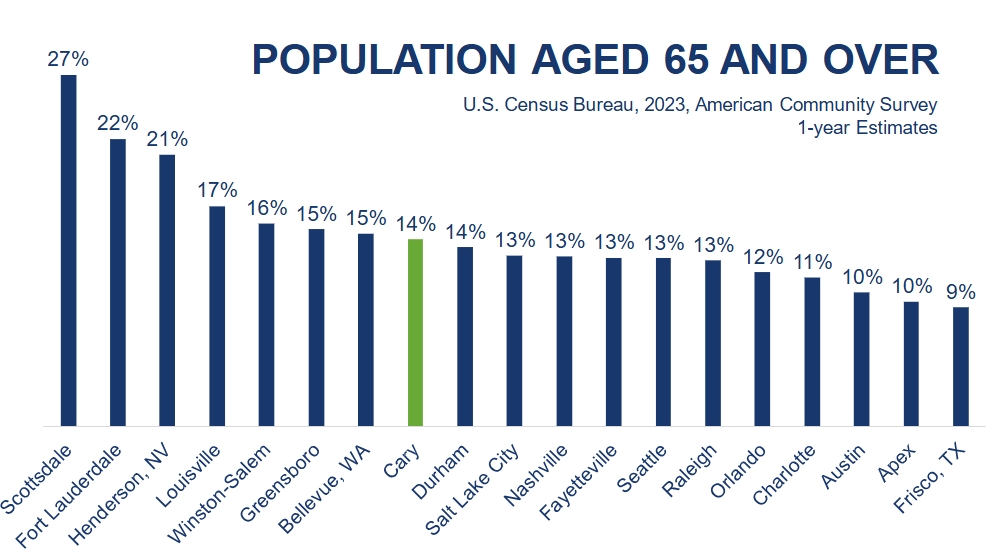
- 14% of Cary’s population is over 65
- 25% of Cary’s population was foreign born
- 29% of Cary is working from home
- “As Cary runs out of land for development and enters a new phase of slower growth in the next 10 to 20 years, the Town could experience a declining rate of revenue growth.”
- Influx Subsidy ERA is Over – Yet the Built Environment remains and is aging & along with our residents
- You can’t have stable services, low density, and low taxes together.
- Stable services with low density mean higher taxes.
- Stable services with low taxes mean more density.
- Low density and low taxes mean cuts in services.
The next presentation focused on the LIVE chapter of the Cary Community Plan. Here are some notes that I took away from that presentation:
- Our Values
- Maintain and enhance existing residential fabric buildings with strong design
- Create new sustainable mixed-use neighborhoods
- Include additional residential choices for variety of lifestyles, ages, cultures, income
- Competing Goals
- High Property Values vs Affordability
- Preservation vs Evolution
- Suburban Character vs Densification
- Redevelopment vs Additional Supply
- Rehabilitation and Preservation: over half of homes were built before 2000 with most near Cary’s core where incomes are lower on average
- New Home Production: Residential market remains strong with potential demand for a balanced mix and additional 1,975 homes per year
- Household Stability: Households are cost stable. Lowest income residents are experiencing high-cost burden, increasing vulnerability to housing instability
- 38,221 of Cary’s 70,780 homes were built before 2000.
- Oldest homes are largely in downtown Cary and south/southwest
- Old housing occupied by households with lower income on average
- Cary’s existing housing supply is 73% single units and 27% multi-family housing
- Median price for homes on the market is $620,000
- Multi-family rental housing is averaging $1720/month
- 5% of Cary households are below the federal poverty level
- The average household size is 2.61
- 29% of Cary households are non-family
- By 2040 there will be demand for an additional 39,500 new homes in Cary
- By 2040 there will be demand for an additional 948 multi-family units and 1027 single-family units (some of which could be attached)
- Cary added 443 multi-family units in FY2024 and 996 in FY2023, which is well below the five-year average
- Goal is to encourage a balanced mix of future housing
- Housing stability has proven to provide a lower crime rate, a higher employment rate, a higher graduation rate, a higher generational wealth, a greater social connection, and improved mental health
- Those that are housing cost-burdened experience food insecurity, a health and well-being impact, higher divorce and parental stress, lower generational wealth, and housing instability & homelessness
- Cary median home price is $620,000 which requires $180,000 of income
- Cary currently has Stable Homes Cary, Journey Home Program with The Carying Place, and other partnerships to increase affordable opportunities
The next presentation focused on the SHAPE chapter of the Cary Community Plan. Here are some notes that I took away from that presentation:

- Cary is evolving. This includes demographics and development patterns. As Cary runs out of land there will be more infill and redevelopment.
- As Cary runs out of land for development and enters a new phase of slower growth in the next 10 to 20 years, the Town could experience a declining rate of revenue growth.
- The Imagine Cary Community Plan describes what we are experiencing today.
- The Future will be different from the past. Imagine Cary articulates the Town’s vision and values to set the course for achieving Cary’s desired future.
- On average, 80% of new revenue growth comes from new tax base to the Town. As growth slows due to limited land for development, new revenue generation models will be needed to maintain the level of service residents have come to expect.
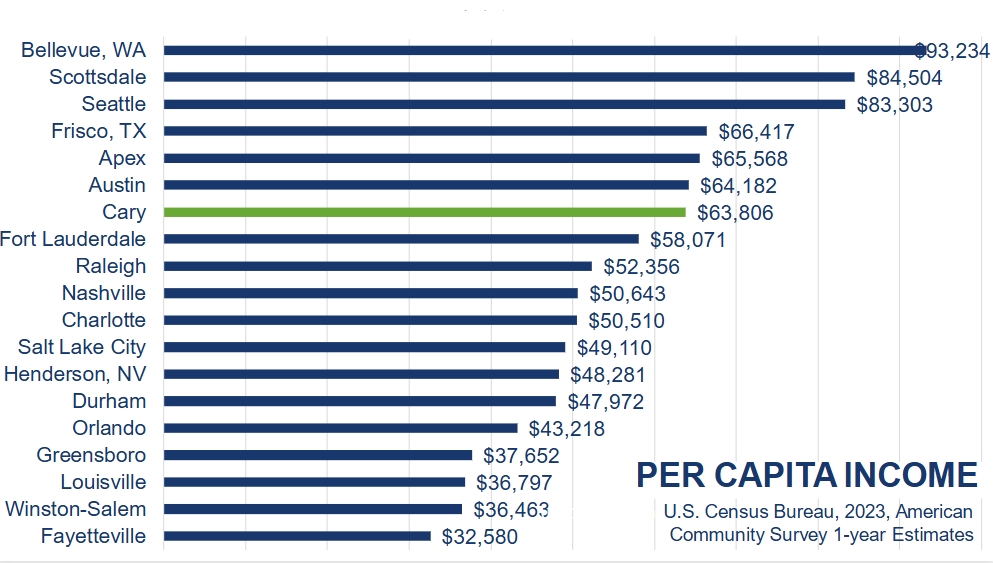
- Per capita income in Cary is $63,806
- Cary has 110 detached single units and 127 attached single units under construction
- There are currently 1,521 multi-family units under construction
- There are currently 1,462,926 square feet of non-residential under construction
- In 2015 Cary had 18% of undeveloped land. Today that is 14%. There is 12.4% in the pipeline
- With both limited land for development and the presence of aging commercial and residential developments, the Town faces a changing paradigm where new projects will increasingly come in the form of infill development and redevelopment of existing properties.
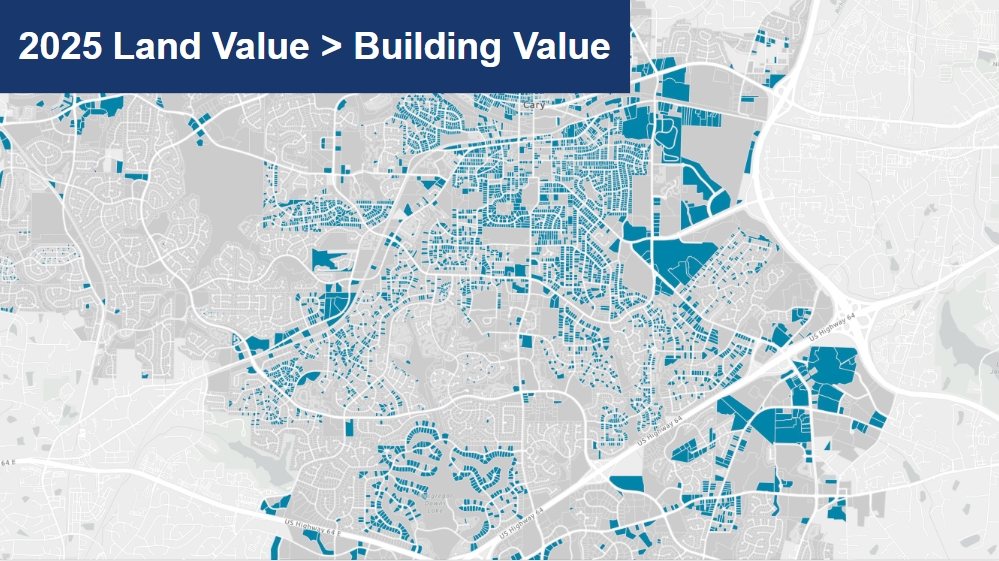
- There are many properties in Cary where the land value is greater than the structure’s value. For example, inside the Maynard loop and MacGregor.
- There were 67 teardown and rebuilds from 2018 to 2025
- The One Walker property had a value of $306,867 in 2010. It is now worth $56,472,692
- 120 and 124 Urban Street had a value of $227,561 in 2010. It is now worth $2,401,088
- Cary’s Business Improvement District has an assessed value of $500 million with around 35% of the land exempt from taxes. It was established in 2012
- Cary needs to upgrade major water lines on Kildaire which gives us an opportunity to transform Kildaire into a vibrant, walkable, urban mixed-use corridor
The last item on Friday was a driving tour of District D with Cary council, staff, and public in attendance. We visited Parkside Town Commons, Alston Yards, Park Overlook, Amberly, Earnest Jones, Diavolo at New Hope, the American Tobacco Trail, Destin, the future White Oak Park, Duke Health, Virdis, Bell Canto, Thomas Brooks Park – USA Baseball, Mills Park School and compost site, McCrimmon Neighborhood Park, Carpenter Fire Station Park, and Alston Regional Destination Center.
The first presentation on Saturday focused on the SERVE chapter of the Cary Community Plan. Here are some notes that I took away from that presentation:
- Cary is recognized nationally as a service leader.
- The level of service and priorities are determined by the council.
- The SERVE values are equitable and inclusive governance, high-quality public services, and comprehensive and top-quality facilities and infrastructure
- Cary’s population is projected to be 270,000 by 2040.
- Cary’s demographics in 2040 are projected to be 45% white, 5% black, 25% Asian, and 15% Hispanic
- Since 2017 Cary has added 30 miles of street maintenance, 47 miles of sidewalks, 29 miles of greenways, 132 miles of water mains, 81 miles of sewer mains, 13 miles of stormwater pipes, 85 miles of fiber, 23,632 hours of public transit. It has seen the median home price go from $356,800 to $647,748. The median household income has gone from $99,209 to $125,000.
- Operational demands for maintaining the level of service, infrastructure, and facilities include:
- Maintenance of roads, utilities, and public buildings
- Expanding smart systems for waste and traffic management
- Renewable energy initiatives for town facilities
- World-class facilities and competitive programming
- Construction challenges include supply chain issues, inflation, market driven industry, skilled labor, and availability of materials
- Raw Material Costs in the last 5 years:
- Rebar $52 to $119.76 (130%)
- Asphalt $428.05 to $550.00 (28%)
- Concrete $150.45 to $215.00 (43%)
- Sidewalk Construction $20 linear foot to $60 linear foot (200%)
- Street Resurfacing $12.25 sq yd to $16.85 sq yd (38%)
- Sanitation truck regular $299,317 to $416,496 (39%)
- Fire and police additional demands since 2017
- 6,427 single family units
- 5,871 multi-family units
- 7,589,221 sq ft of commercial space
- Cary Fire Department remains an Insurance Services Office (ISO) Class 1 and internationally accredited agency, 1 of 121 departments nationwide to hold both
- Fire responses since 2017 are up 59.76%
- Cary provides high-level fire services following national consensus standards
- Past investments have allowed the fire department to maintain current service levels
- Continuous investments will be needed to maintain response model service levels
- Cary remains one of the safest communities in the nation
- Cary police experience operational impacts including increased calls for service, special events, emergency response times, growth in 3 counties, time to hire and train, space for evidence, training, and storage, and future capital improvements
- In the last 5 years property crime has been up and violent crimes are down.
- Most property crimes are crimes of opportunity like leaving doors unlocked.
- Challenges to our IT include rising cyber threats, potential breach incidence, regulatory framework, and protecting sensitive data
- IT opportunities for the future:
- Enhancing municipal services with real-time data and automation and data management
- Pedestrian and bicycle counters, drones, smart meters, and stormwater sensors
- LoRaWAN network deployment for IoT Connectivity and efficiency
- Integrating AI and IoT to create a sustainable, intelligent urban ecosystem
The last two presentations on Saturday focused on Budget Prioritization. A lot of the presentation material was educational material about budgets. Here are some notes that I took away from those presentations:
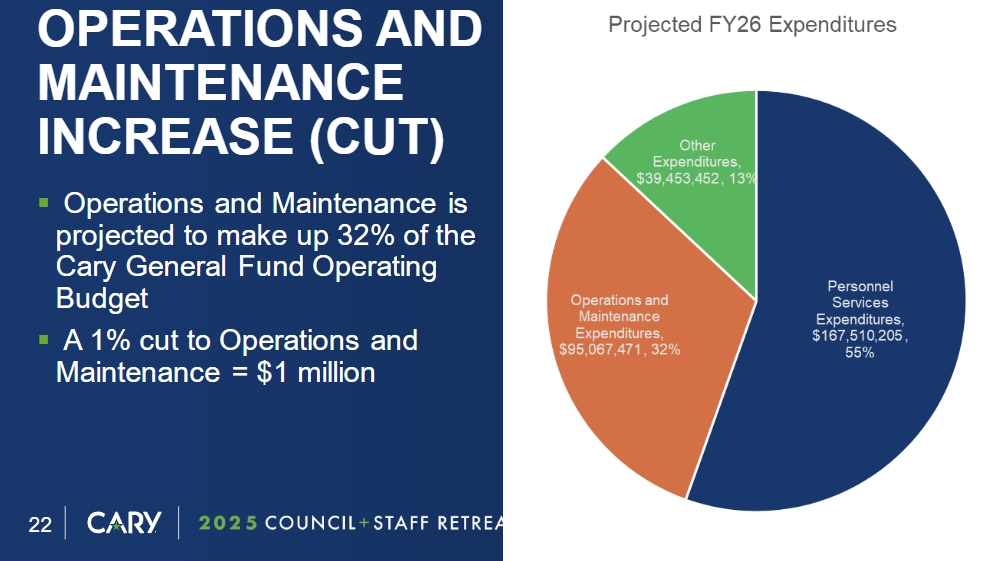
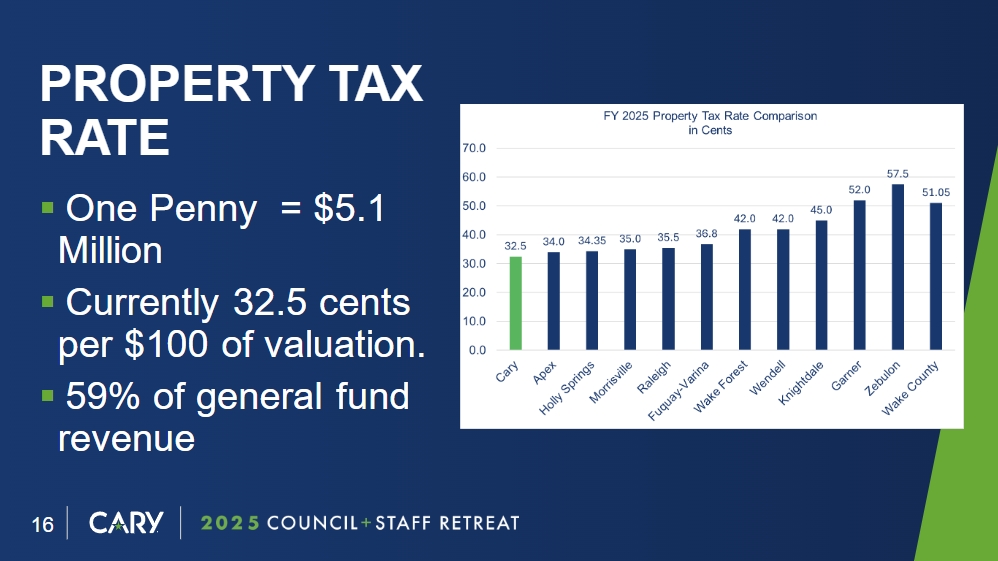
- 80% of our General Fund revenue is from property tax and sales tax.
- Cary’s assessed value from reevaluation went from $36 Billion to $52 Billion
- Property and sales tax revenue are growing much slower and are basically flat.
- 71% of our expenses are Police, Fire, Public Works, Parks, and the general government that supports all services. Those expenses impact our tax rate the most.
- Cary is in maintenance mode. Staff recommend continuing projects that are mandated, maintain existing infrastructure, and underway and at a point where it’s difficult to stop. Staff recommend stopping projects that are cost-prohibitive or haven’t begun or at a point where work can be stopped.
- Cary needs recurring funding of $5 million a year to replace critical technology and maintain Cary facilities.
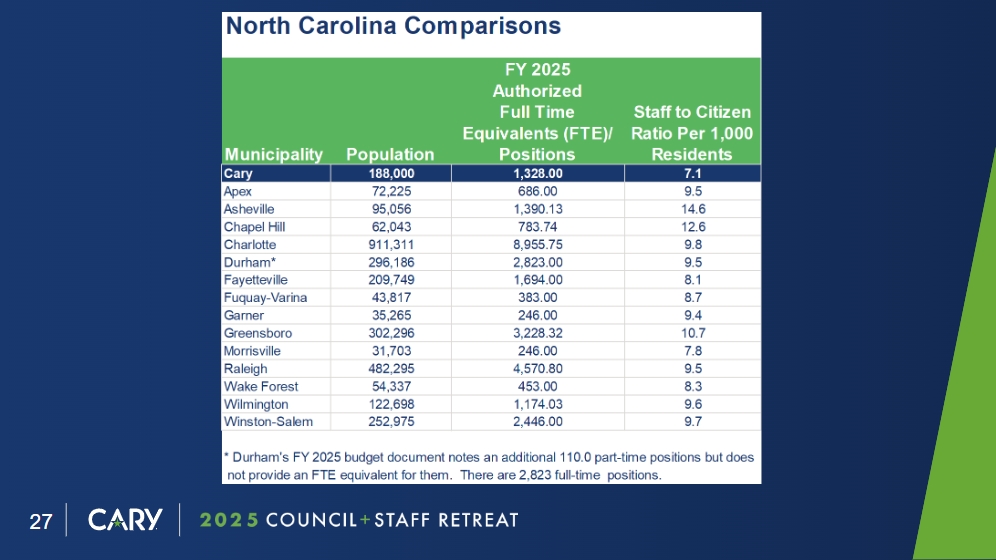
- Cary currently has 1328 full-time employees that make up 53% of the budget. A 1% cut would result in eliminating 14 employees.
- Cary’s fund balance policy (savings) is set at 33.3% of the operating budget. A 1% reduction in policy is $2.8 million.
- The Fund Balance:
- Avoid Local Government Commission warnings
- Help protect credit rating and obtain lower interest rates on borrowings
- Cash flow
- Avoid short-term borrowing
- Reserve for emergencies, unforeseen events, and unexpected opportunities
- Cary’s debt service policy is to stay under 20% of operational expenditures. We are well under that. $10 million of debt is about $1 million in recurring debt service.
My takeaways:
I believe this retreat marks the start of a new chapter for Cary. The days of enjoying the highest quality of life with the lowest tax rate in Wake County are behind us. With flat revenue growth and rising expenses, both the council and citizens will face a crucial decision. Will we opt for higher taxes moving forward, or are we willing to accept no longer being the best of the best? It’s important to recognize that being the best often impacts critical services, such as fire and police, where it could literally mean the difference between life and death. The dialogue between staff, the council, and the public will continue over the coming months, with the budget set for approval on June 26th.
Waverly Place Rezoning
There was an email campaign launched against the council by people opposing the Waverly Place rezoning. It included comments like “You should be ashamed of yourselves for even considering this rezoning” and “I don’t have faith that you care about anything other than making money.”
Due to the number of emails I had to do a cut-and-paste response to try and address them all:
“…
Misinformation about rezoning
Some information and statements sent to me are incorrect. You can find factual information here.
Who is proposing
This is not a council proposal it is a proposal from the applicant who is the owner of Waverly Place. The owner/applicant is HGIT (Hines Global Income Trust). FYI, they were partners in building Fenton.
The Applicant Doesn’t Care and is Trying to Make Money
While a rezoning doesn’t go with the applicant but the location, the applicant in this case lives in Cary and plans to remain here.
Why are we allowing this
We aren’t “allowing” anything but are reviewing. The mayor and council have a sworn duty to review all applications. Our job is to determine if the request matches the Cary Community Plan. That plan was created by Cary citizens over a three-year period, approved by council in 2017, and an update was approved this year. That is what guides our development.
There are too many apartments
The type of use in certain areas is determined by the Cary Community plan.
Cary is over 90% built out. The remaining land is hard to develop because of topography and other reasons. That means future requests we see are mostly redevelopment. Shopping centers will see redevelopment. More on that later.
Land in Cary is VERY expensive. For Instance, almost all homes inside the Maynard Loop, most in MacGregor, and some in other areas have land that is worth more than the structure. So, to make projects viable applicants increase density.
The region is short on housing supply. There is great demand for all types of housing including apartments.
Those are the reasons we are seeing multi-family proposals. But again, it must match the Cary Community Plan which was created by Cary citizens. That is why there are mostly apartments being proposed.
The Future of Large and Medium Shopping Centers
The future of large and medium shopping centers looks bleak. Why? Shopping habits have changed (including mine). It is much easier to order something online and have it delivered to your front door rather than going to a shopping center.
Building Height
There will be balloons floated on Tuesday, February 25th. This will allow everyone to see from all directions what the maximum building height would look like. Living close to the area I believe it will not be visible from Lochmere but will be seen on Tryon Road and Kildaire Farm. Of course, the building height is similar to the hospital across the street.
Stormwater
This was a concern of mine that I mentioned at the public hearing especially since they were grandfathered in. It is my understanding that the applicant has added conditions that will make stormwater mitigations so that after development the stormwater situation would be as good or better than it currently is .
Traffic
Cary used to have an ordinance that required road capacity before development. Makes sense right? Well, court cases showed that was an extremely risky ordinance so it was removed. The roads adjacent to Waverly are at their maximum widths. Any improvements would likely be in the form of turn lanes. As far as road improvements, we can’t require much from the developers. While you can deny a rezoning based on traffic, doing so in a location where both roads are at their maximum widths is a big risk.
Tryon and Kildaire Farm Road are both state roads. That is unfortunate since state funding is already lacking and federal funding will likely have additional funding cuts. I doubt you will see improvements on those roads any time soon, but I am hoping I am wrong.
Most of the traffic on Kildaire and Tryon is pass-through. That means people are not originating or terminating at Waverly. That also means that future traffic will get worse no matter what happens at Waverly. Why? This region, not only Cary, will see significant growth in the next ten to twenty years.
You are doing this to make money
I will ignore how insulting that is and speak to the men and women who make up the council and staff.
Cary is blessed to have some of the finest men and women serving on the council. They have a wide variety of backgrounds including IT, business owners, and retirees. I have seen MANY different councils around the country (in my consulting job) and there is nothing that compares to Cary.
Cary council members make around 12K a year, the mayor pro-tem a little more, and the mayor around 15K. So no, we don’t make money off anything.
Our staff was ranked the #1 government a couple of years ago. They are by far the best of the best
What’s next?
It will go to the Planning and Zoning board, a council appointed advisory board, for their review and recommendation as to whether this meets the Cary Community Plan.
It will come to council in a few months for a vote. If it passes, then staff will review site plan submittals. If it fails, then they have to wait a year to resubmit another request.
It is important to know that they have the right to redevelop certain uses now without any council vote. For example, they could build a Dollar General. I certainly don’t want that.
I think it is in everyone’s best interest to work with the applicant.
IMHO, this and all shopping centers will need to consider redevelopment or die. If they die, then we risk blight and crime. We have seen MacGregor Village struggle. We are currently seeing the shopping center with Big Lots suffer. That will be an interesting one to watch. Of course, the Cary Town mall died and was bought by EPIC. They tore it down and currently have no proposals to do anything with the land.
I hope this information is helpful. I would encourage you contact Katie.Drye@carync.gov if you have any questions.
…”
Mayor’s Mailbox
- A complaint that we need to “right size our local government”.
- A complaint that Cary did not brine a cul-de-sac.
- A complaint that DEI is supported in WCPS. And that “Democrats lost by a landslide for a reason”. And that WCPSS support of DEI will cause them to lose federal funding.
- A request to “do everything in your power in NC to resist Trump in any way you can.”
Next Week
Next week’s activities include staff meetings, the funeral for Sallie Jones, a taping of Cary Matters, a North Carolina League of Municipalities state dinner, a State of Cary taping, and a meeting of the North Carolina Metro Mayors.
Well, that is all for this week. My next post will be on Sunday, March 2nd, 2025. Although I have Facebook and Twitter accounts, those are not the best means of communication with me. Please send all Town of Cary questions or comments to Harold.Weinbrecht@carync.gov and email personal comments to augustanat@mindspring.com.
 Harold's Blog