
Purpose of this Blog
It is my hope that this blog will provide insight not only into who I am meeting with on behalf of the Town, but also the topics we discuss. I believe strongly in open and transparent government. This blog is one of several initiatives I implemented when I became mayor in 2007 to make the governmental process more accessible to our citizens.
This blog is written with sincerity, honesty, and a commitment to accuracy so our constituents can better understand the work we do. After all, we work for them!
#9 Best Mid-Sized City for College Grads
CoWorkingCafe ranked Cary is the 9th best mid-sized city in the US for college grads. They based their ranking on job percentage for recent graduates (Cary – 6.7%), unemployment rate for people in their 20s (Cary – 5.0%), and median income for graduates (Cary – $90,044).
Meeting with Citizen on Cost
On Monday afternoon, I met with the Interim Town Manager and a citizen to discuss opportunities for reducing costs. The citizen presented a proposal in which his business would analyze several categories of expenses and identify lower-cost alternatives.
State of Cary – Coldwell Banker Howard Perry & Walston
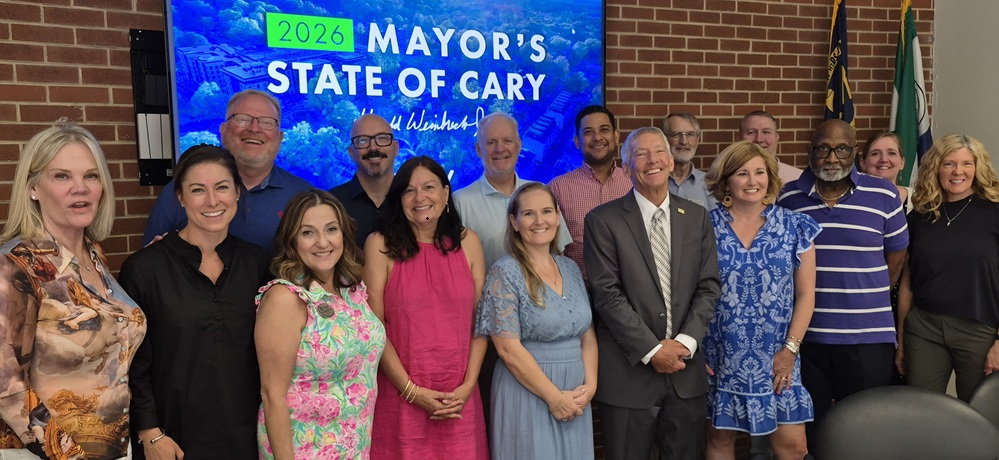
On Tuesday morning, I presented an updated version of the State of Cary address to realtors from Coldwell Banker Howard Perry & Walston. During the question-and-answer session that followed, several attendees expressed concern about the number of apartment developments and a desire to see more for-sale housing options. I explained that the Town’s role in the development process does not allow us to distinguish between rental and for-sale housing. They also inquired about the location of future development opportunities in Cary, and I noted that the southern part of Cary contains the largest amount of undeveloped land available for future growth. The visit lasted approximately one hour and fifteen minutes.
Sears Farm PDD Amendment Proposal Meeting
Tuesday afternoon, I met with representatives regarding the Sears Farm PDD Amendment proposal. They walked me through their proposal and discussed the good-faith efforts they have made to work with Searstone. It appears that most of the disagreement between the two parties is about Lot 41, which is adjacent to the pond. I am hopeful that they can reach a compromise before the Council votes on the matter.
Council Work Session
Council held a work session on Tuesday evening to discuss the meeting schedule, e-bikes, and a potential smoke-free ordinance.
The council and staff tentatively set August 18 as the date for the next quarterly meeting. They also discussed possible future joint meetings with the Apex, Holly Springs, and Morrisville councils, as well as the Chatham County Board of Commissioners and the Wake County Board of Education. Because there was interest in pursuing these opportunities, staff will work to coordinate and schedule the meetings.
Staff provided a comprehensive overview of e-bikes, mopeds, and electric motorcycles, explaining that the primary distinction between these devices is their speed, making enforcement and identification challenging. Staff also updated the council on policies adopted by neighboring municipalities. Currently, Cary allows e-bikes with a maximum speed of 15 mph. Council directed staff to develop a dedicated webpage, launch a public education and social media campaign, and draft ordinance amendments that would establish penalties, define mobility devices, and set sidewalk speed limits. The proposed ordinance changes will be presented to council for further discussion later this year.
The final work session topic was a potential smoke-free ordinance, with much of the discussion focused on e-cigarettes and vaping products. Staff reviewed the town’s current ordinance, which prohibits the use of lighted tobacco products in town buildings and public transportation vehicles. They also provided background on the wide range of tobacco and nicotine products now available compared to when the ordinance was adopted in 2007. The discussion included a review of policies in neighboring municipalities.
Council did not reach a consensus on a preferred approach and directed staff to develop additional options for consideration, including:
- Adding vaping products to the list of prohibited items in town buildings and vehicles
- Expanding the ordinance to include tobacco-free and nicotine-delivery products
- Extending regulations to town-owned outdoor facilities
- Considering regulations for privately owned public spaces
Staff will bring these options back to council for consideration later this year.
Council Meeting
Thursday the council held its last meeting of the fiscal year in which we passed our FY2027 budget. The agenda included one consent item to call for a public hearing, a public hearing on the Hatcher Property 23-REZ-14, and two discussion items.
The public hearing on the Hatcher Property had speakers mostly in favor of the rezoning proposal. This will go to the Planning and Zoning Board for their review and recommendation and return to council for a vote in a few months.
The first discussion item was the bid award for the construction of the GoCary Bus Operations and Maintenance Facility to Swinerton Builders for a total bid amount of $49,387,755.00. Capital costs for the facility will be fully funded by the Wake Transit Plan and a Federal Transit Administration Buses and Bus Facilities formula grant. Existing appropriations from capital project GC-10030 will fully fund the project. This was unanimously approved by council.
The final discussion item was the FY2027 budget. The Fiscal Year 2027 Recommended Operating and Capital Budget totals $573,475,875, a 12.2% increase from the prior year.
This budget:
- is rooted in Council and public priority input
- represents the single largest investment in public safety in Cary’s history
- is the first step in instituting a predictable, transparent approach to funding Cary services
This budget is the first step in a three-year smoothing approach that addresses rising operational costs and capital investment needs in a predictable and transparent manner. This budget increases Cary’s property tax rate by 2.75 cents to $0.3675 per $100 of assessed valuation. A $2-per-month increase to the solid waste fee and a 4% increase in utility rates are also recommended. I made the following statement during the budget discussion:
“I would like to thank the staff who worked exceptionally long hours to complete this budget. It was a significant undertaking, particularly this year as we continued addressing the challenges that emerged following the former manager’s breach of trust.
I mention the breach of trust because it is the context in which this budget was developed.
That breach led to inaccurate information being provided to the Council over several years, leaving critical needs unaddressed, particularly within our police and fire departments.
For 18 consecutive years, Cary maintained the lowest property tax rate in Wake County. Based on what I know today, I believe the low tax rates of recent years were achieved, at least in part, through an incomplete and misleading assessment of the Town’s long-term needs. The Council was repeatedly presented with information suggesting that a tax increase was unnecessary when, in reality, additional revenue was needed simply to sustain existing service levels.
The result has been a significant backlog of public safety and infrastructure needs. Cary has not added a new police officer position in more than a decade and is currently understaffed by 89 officers. At the same time, our growing community requires two additional fire stations to meet increasing service demands.
We have now reached a point where public safety service levels could be affected if these staffing and infrastructure needs are not addressed. In fact, some areas of Cary are already experiencing longer average police and fire response times. This budget is designed to confront those realities, address critical needs, and begin closing the gaps created by years of underinvestment and misleading forecasting.
Almost all of the egregious spending undertaken by the former manager in recent years has occurred without Council knowledge. Fortunately, the overall impact on the budget was limited. The Council and Interim Manager are already implementing changes to strengthen oversight and prevent similar extravagant spending in the future. We also anticipate recommendations from both the internal investigation and the State Auditor, which will lead to additional improvements in our financial controls and governance practices.
Approximately 60% of our revenue comes from property taxes and 21% from sales taxes. Both revenue sources have remained relatively flat, as population growth has slowed to about 1% over the past two years and sales tax collections have not significantly increased. At the same time, more than 80% of our expenditure is dedicated to Public Safety and Public Works, where costs continue to rise with double-digit inflation in many areas of town services.
Maintaining the high level of services that Cary residents have come to expect over the past several decades will require significant investment over the next three years.
Now more than ever, economic development must be a priority. With the community largely built out and population growth slowing, economic development is one of the few sustainable ways to expand the tax base and reduce pressure for future property tax increases. Unfortunately, this budget reduces funding for the second consecutive year to the organization that leads much of our economic development efforts, the Cary Chamber of Commerce. In my view, that is a mistake and sends the wrong message to our business community.
Strategic investments that deliver measurable economic returns must remain a priority. Cary’s world-class facilities, including WakeMed Soccer Park, USA Baseball, and Cary Tennis Park, attract major events, draw visitors from across the region and nation, and generate millions of dollars in economic impact for our community.
Choosing not to invest in assets that consistently produce these returns would be shortsighted. Economic development is not optional; it is essential to maintaining both our quality of life and a competitive tax rate in the years ahead. These investments help sustain our high quality of life, support local businesses, and maintain a competitive tax rate for residents. As we plan for the years ahead, investments that create long-term economic value should remain a core component of every budget.
The good news is that this budget moves us in the right direction. At the annual council–staff retreat in February priorities identified by council, in order, included public safety, capital investment, high performing staff, affordability, maintaining service levels and facilities.
This budget begins to address the significant backlog created by the shortage of police officers and the lack of fire stations, equipment, and personnel. It is important to emphasize that this budget represents the first phase of a three-year public safety recovery plan. As a result, future budgets will also need to prioritize public safety investments to fully address these critical needs.
This budget also makes meaningful progress in addressing the Town’s capital needs, with 54% of the capital budget dedicated to maintaining parks, roads, and other community infrastructure. Key investments include the widening of Carpenter Fire Station Road, the Multi-Modal Center, and the design of two new fire stations.
However, the budget does not fully keep pace with the growing needs of our roads and sidewalks. While $3 million was allocated for sidewalk improvements, an additional $3.7 million was needed this year just to maintain current service levels. As a result, we continue to fall behind. Similarly, road maintenance funding fell approximately $5 million short of identified needs, further increasing the maintenance backlog.
Addressing these shortfalls will require significant investment in future budgets. Delaying road maintenance only increases long-term costs, as road conditions continue to deteriorate over time. Even a one-year delay can result in substantially higher repair and reconstruction expenses, making timely investment both fiscally responsible and cost-effective.
The budget does a good job investing in our exceptional staff who have suffered under decisions made by the previous manager. It is important to note that out of 55 additional staff in this year’s budget, a budget director and two internal auditors are included.
Affordability was identified as a top priority by this council. In fact, a penny of the tax rate was specifically dedicated to affordable housing after advocacy from a special-interest group. As a result, the council budgeted an additional $700,000 in addition to the manager’s recommendation.
Unfortunately, that additional funding was directed at organizations that had already been included in the budget and did not result in the creation of additional housing units. In fact, one of those organizations still lacks sufficient funding to move its project forward.
I am concerned that making spending decisions in response to requests from a special-interest group, particularly one that includes individuals who worked on council campaigns, is not sound public policy. Simply allocating more money to a problem does not guarantee meaningful results.
Many residents are expressing concerns about affordability in general, not just affordable housing. Affordable housing initiatives are primarily intended to benefit future residents, while current residents bear the cost through higher taxes or cuts in services. As a result, this is actually adding more financial burden to the people that are expressing concerns with affordability.
At their core, tax rates reflect our values and priorities as a community. If we want Cary to remain one of the premier places to live, work, raise a family, and run a business in the nation, we must continue to evolve, adapt, and invest in our future.
This budget establishes a tax rate of 36.75 cents. While it does not achieve all the goals I would like to see accomplished, it represents meaningful progress in several important areas and positions our community to continue moving forward.
I have expressed several concerns about this budget, and to some this may be difficult to hear. However, my responsibility is to be candid about both the strengths and shortcomings of the decisions before us. On balance, I believe this budget moves Cary in the right direction, and for that reason, I will support it.”
The council approved the budget unanimously. While adoption of the budget fulfills the Town’s legal obligation, it does not mark the end of Cary’s budget process. Council will continue to consider emerging opportunities and priorities at quarterly meetings, regular meetings, and work sessions as opportunities arise.
Town Manager’s Report
Council,
Thank you for your work on the FY 2027 Budget and for adopting it last night. This year’s budget process included more public input than any in Cary’s history, and I appreciate the involvement of you, our Boards and Commissions, many staff members who contributed, especially our budget team, and everyone who participated throughout the process.
This budget provides the resources needed to deliver the everyday services that keep Cary running, from public safety and utilities to parks, transportation, and an abundance of behind-the-scenes work residents may never see but rely on every day. It also reflects Cary’s continued commitment to strong financial stewardship as we plan for the future.
As a reminder, there will not be a Weekly Report next week since Town Hall and most staffed facilities will be closed on Friday, July 3, in observance of Independence Day and America’s 250th Anniversary.
Have a great weekend.
Russ Overton
Interim Town Manager
Water Main Construction Begins at Farmington Woods
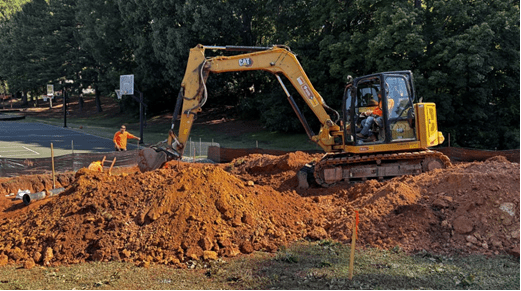
Construction has begun on a new water main project at Farmington Woods Elementary School to close a loop in Cary’s water distribution system, improving system resiliency. The project includes utility locating, installation of the new water main, system testing, and restoration of affected grass and sidewalks. Work will primarily occur on school property, and while traffic impacts are not anticipated, nearby residents have been notified of the project. All work is expected to be completed within two months, before the start of the school year on August 17, weather permitting.
Morrisville Square Sewer Repair Complete
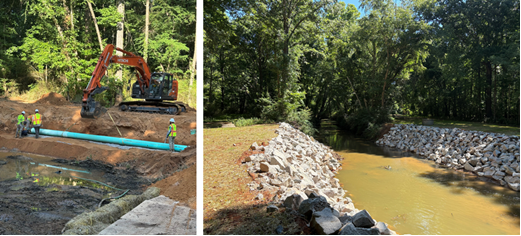
During the week of June 8, contractors working on behalf of Cary completed sewer and creek bank repairs along Crabtree Creek near Morrisville Square. Fallen trees had blocked the center of the creek channel, diverting water toward the banks and causing significant erosion. The erosion resulted in a creek bank failure and damaged a 15-inch sewer line. Staff diverted sewer flow to an alternate outfall line while contractors removed the fallen trees, repaired the sewer line, and stabilized the creek banks with boulders to help prevent future erosion.
Old Apex Water Storage Tank Recoating Complete
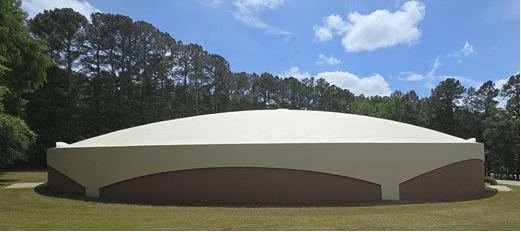
As part of Cary’s ongoing water system asset management program, restoration work was recently completed on the Old Apex Water Storage Tank, a 3-million-gallon ground storage tank that has served Cary’s Central Pressure Zone (CPZ) since 2001. The project included surface preparation, minor repairs, and application of a new protective coating. The coating is expected to protect the tank from environmental exposure for up to 10 years, extending its service life and supporting long-term system reliability.
Pride in the Park
On June 13, thousands of people gathered at Downtown Cary Park for Pride in the Park, a celebration of the LGBTQ+ community and its allies. The event featured more than 50 vendors, arts and crafts activities, and a silent disco. Pride-themed lighting was also displayed throughout downtown Cary in recognition of Pride Month.
Cary for the Cup Recap
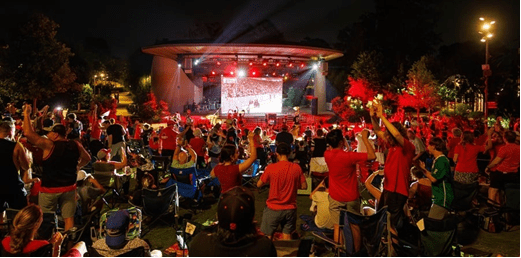
Downtown Cary Park hosted two Cary for the Cup Watch Parties during the Stanley Cup Final, with Hurricanes fans filling the Great Lawn on June 11 and June 14. The first watch party drew an estimated 800 fans, with more than 1,600 visitors to the park during the event.
Attendance increased significantly for the June 14 watch party, with staff estimating 1,500 to 1,800 fans gathered on the Great Lawn and more than 3,500 visitors to the park during the event. Visitors also traveled from nearly twice as many origin points as at the first event.
Staff enhanced the championship atmosphere by incorporating red lighting during Hurricanes goals and key game moments and distributing Canes-themed Downtown Cary Park stickers and red glow sticks. Across both events, 87% of visitors traveled from within 20 miles of the park, demonstrating strong local participation while reinforcing Downtown Cary Park’s role as a regional destination.
Juneteenth Celebration
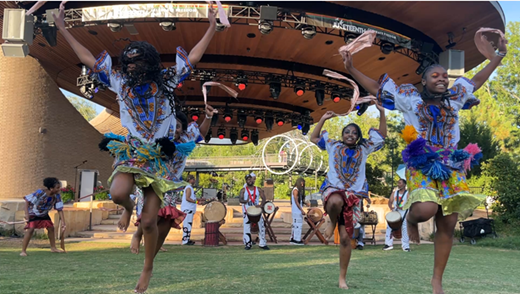
More than 1,000 people attended the annual Juneteenth Celebration at Downtown Cary Park on June 20. This year’s theme, “Freedom Dance,” highlighted movement as a form of expression, resilience, and joy. Through performances rooted in African dance traditions and contemporary dance, the event explored the role of movement in storytelling and cultural traditions.
Important Dates
There are no meetings scheduled for next week.
Council Initiated Items
The council has a process that allows members to introduce items for discussion at meetings, often leading to further action. Given the recent increase in these requests, I will begin sharing them here along with my perspective on their pros and cons.
Temporary moratorium on Data Centers
This proposal was submitted by Mayor Pro-Tem Bush, and I provided the second. It was brought up at the May 28th Council meeting. It will come back to council after the staff has gathered information.
Data centers are centralized facilities that house IT equipment for storing, processing, and distributing massive amounts of data. While they are the vital backbone of the modern internet and AI, they also pose notable environmental and community challenges by requiring massive amounts of electricity and millions of gallons of water. This proposal would direct staff to put a moratorium on data center approvals.
PROS:
- They generate significant long-term property and sales tax revenue for local municipalities, often offsetting the need to raise taxes on residents.
- They provide the essential computing power required to run the cloud, stream media, and train heavy AI models.
- Modern facilities offer unparalleled uptime, physical security, and disaster recovery protections for critical business information.
- Unlike large manufacturing plants or warehouses, operational data centers generate minimal daily traffic and produce very little localized air pollution.
CONS:
- We may not have authority to permanently prohibit them.
- They demand immense amounts of electricity and millions of gallons of water for cooling, which can strain local utility grids and drive-up energy costs for surrounding communities.
- Unless heavily offset by renewable energy sources, heavy reliance on power can prolong the use of fossil fuel plants and contribute to electronic waste.
- The constant operation of high-powered cooling fans and backup generators can create significant, round-the-clock noise disturbances for nearby residents.
- While construction creates many temporary jobs, fully operational data centers typically require very few on-site staff, delivering fewer permanent local jobs than other large-scale developments.
Partnering with the school board to pilot school zone safety improvements
This proposal was submitted by Council Member Bansal, and I provided the second. It was brought up at the May 28th Council meeting.
Several schools in Cary, particularly middle schools and high schools, are experiencing transportation safety concerns on and around school property. While the schools are responsible for transportation operations on campus and NCDOT oversees roadway infrastructure decisions, progress on improvements has been slow and resident complaints have continued to increase. This proposal would direct staff to work collaboratively with the schools on programs and strategies to help address these concerns.
PROS:
- Allows the Town to take a more proactive role, even when we are not the primary decision-maker.
- Responds to growing community concerns regarding school transportation safety.
CONS:
- The Town is currently understaffed, so this effort could require shifting staff resources away from other projects.
- Potential solutions could result in additional costs to taxpayers if Cary contributes funding toward implementation.
E-Bike Safety
This proposal was submitted by Council Members Bansal and Richards and presented at the April 16th meeting. It was part of our June 23rd work session.
The council initially launched a pilot program in June 2022 to allow e-bikes. After a one-year trial period, the program was made permanent, with a posted speed limit of 15 mph on greenways. Recently, however, there have been complaints that e-bikes, scooters, and similar devices are traveling at excessive speeds and creating potentially hazardous conditions.
PROS:
- We are listening to our citizens’ complaints.
- Preventing e-bikes and scooters will possibly make greenways safer.
CONS:
- There is basically no way to enforce an ordinance that has e-bikes or not.
- Any enforcement effort would require additional officers and officers’ time. We are currently underfunding officers and require overtime to maintain existing levels of service.
- We are revisiting a decision that was made after a one-year trial and review of data.
Council will vote on a draft ordinance of this later this year.
Smoke Free Ordinance
This proposal was submitted by Mayor Pro-Tem Bush and Council Member Craig and presented at the April 16th meeting. It was part of our June 23rd work session.
PROS:
- Eliminates toxic secondhand smoke.
- Current ordinance does not match state law and Raleigh/Wake ordinance.
CONS:
- Any enforcement effort would require additional officers and officers’ time. We are currently underfunding officers and require overtime to maintain existing levels of service.
Council will vote on options to add to the current ordinance later this year.
Affordable Housing on Old Library Site
This proposal, submitted by Mayor Pro Tem Bush and Council Member Bansal, would place a podium-style parking deck with affordable housing on the former library site. This has yet to be scheduled for a meeting agenda.
PROS:
- Adds parking across from Downtown Cary Park.
- Create affordable housing units in the downtown area.
CONS:
- May underutilize one of the municipality’s most valuable properties. Downtown Cary Park generates approximately $16 million annually in economic impact, and this site could represent an opportunity for a more transformative use.
- The town has already invested millions in renovating the Ivey-Ellington House, positioning this area as a premier destination.
How Cary Government Works
Cary’s government, like most cities in North Carolina and most mid-sized cities in the U.S., uses a council–manager form of government. This system works a lot like a company, but for local government. Residents elect a council and a mayor, who set policy by passing laws, approving the budget, and guiding the town’s overall priorities. The council then hires a professional manager to run the town’s day-to-day operations.
Think of it like a company: the council acts like a board of directors, making policy and representing the public, while the city manager acts like a CEO, overseeing all departments, such as finance, public works, police, and fire, and managing town staff. The mayor leads council meetings, represents the town publicly, and has limited executive authority. While the council and mayor make policy decisions and receive regular reports, they usually see only high-level summaries rather than the detailed inner workings of each department.
In short, just as a board hires a CEO to run a company, Cary’s council hires a manager to run the town, ensuring professional management while elected officials focus on big-picture decisions and community priorities.
You can find additional information about how Cary’s government works on the town’s website here.
Mayor’s Mailbox
- Complaints on the budget.
- Concerns about fireworks around town causing fires since we are in a drought.
- A complaint about water being turned off after not paying utility bill.
- Concerns about the Hatcher Property rezoning proposal in the Carpenter Special Planning Area.
- A request to create an ordinance to ban bamboo (it is already on our prohibited plant list).
- A story from former mayor Glen Lang about how our firefighters saved his life.
- A complaint about panhandling.
- Comments and recommendations about a smoke-free ordinance.
- Complaints about the Trenton Road rezoning proposal.
- A question about Powell Bill funding.
Next Week
Next week’s activities include staff meetings, an interview with CiviPod, a meeting with GoRail, and the Cary Tennis Classic.
Well, that is all for this week. My next post will be on Sunday, July 5th, 2026. Although I have Facebook and Twitter accounts, those are not the best means of communication with me. Please send all Town of Cary questions or comments to Harold.Weinbrecht@carync.gov and email personal comments to augustanat@mindspring.com.

