
Liz and Cailen Waddell
Many of you have likely heard about Liz Waddell of Cary, who has gone missing while in Grenada. Liz is deeply loved by so many in our community, especially by her husband, Cailen.
I have the privilege of working alongside many dedicated employees, though I don’t always get the chance to know each of them personally. Cailen is an exception. As the leader of our technology team, he plays a vital role in helping us connect with our residents through our work sessions and quarterly meetings. I work with him often and have tremendous appreciation for everything he does.
Cailen and his family have been on my mind constantly. My heart goes out to them during this incredibly difficult time. We are all holding onto hope for Liz’s safe return and are doing what we can to offer comfort, support, and strength to the Waddell family.
If you want to help there is a gofundme page at https://www.gofundme.com/f/help-find-liz-waddell-support-search-efforts-vna73.
Housing Market Update
This week, I received the latest weekly market metrics for Cary from Berkshire Hathaway York Simpson Underwood Realty. Here are a few highlights from the past 30 days:
- 839 homes were listed for sale.
- 144 homes were new to the market.
- The average days on market was 36 days.
- The average list price was $749,328.
- The average sale price was $763,013, indicating many homes are continuing to sell above their asking price.
- 180 homes closed during the past 30 days.
- 144 of those homes sold at their full list price.
These numbers reflect a market that continues to see strong buyer demand, with well-priced homes moving quickly and many sellers achieving their asking price.
Town Manager’s Report
Council,
Yesterday, we held our first All Hands since the Office of the State Auditor and Womble Bond Dickinson reports were released, and it was good to finally share thoughts and hear thoughts from staff now that all the reports are public. We have a great team, and I appreciate the way everyone has shown up and continued to do good work while we’ve been under a level of public attention we’ve never experienced before.
I’m looking forward to seeing everyone next week. Enjoy your weekend.
Russ Overton
Interim Town Manager
7-27-26 Water Resources Update
While the regional drought designation remains in place, Cary’s primary water supply, Jordan Lake, has returned to full capacity, with water levels rising three feet over the past week to an elevation of 216 feet. Staff will continue monitoring conditions and coordinating with neighboring utilities. You can find the full report from our utilities department here.
Temporary Mid-Block Crossing on Kildaire Farm Road
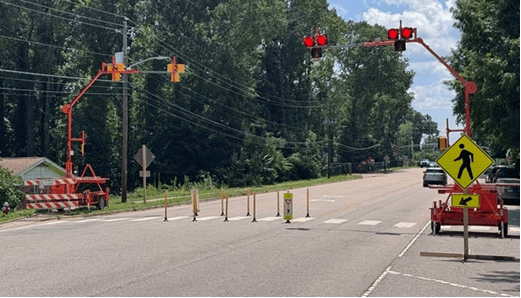
This week, contractors installed a temporary mid-block crossing at Kildaire Farm Road and Meadow Drive as part of the EMS Cary Main Station Project. The trailer-mounted High-Intensity Activated Crosswalk (HAWK) system provides a pedestrian detour while the project installs sidewalks and turn lanes at the intersection of East Cornwall Road and Kildaire Farm Road. The temporary crossing is expected to remain in place for approximately six weeks.
All-Way Stop Conversion on East Durham Road

This week, the intersection of East Durham Road, Wilkinson Avenue, and Bowden Street was converted to an all-way stop with the installation of new LED-enhanced stop signs. Staff used Vision Zero principles and historical crash data from Cary’s data analytics platform to determine that an all-way stop would improve traffic flow at the intersection. The design also includes advance warning signs, improved pavement markings, and thermoplastic rumble strips to increase driver awareness and visibility. Police participated in planning for the conversion and will assist during the transition as drivers adjust to the new traffic pattern.
Planning Bureau Delegation Visit From Japan
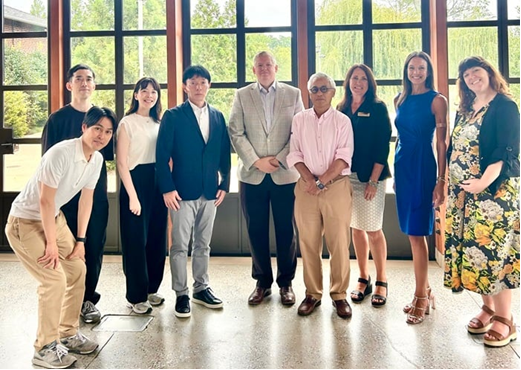
Staff welcomed a delegation from the Kobe, Japan, Planning Bureau to learn about Cary’s approach to planning, urban design, and economic development. Coordinated through the Japan Center in Raleigh, the visit was part of the delegation’s broader tour of the Triangle, which also included Research Triangle Park (RTP) and discussions about the region’s growing economy.
Hosted at the Gathering House in Downtown Cary Park, Assistant Town Manager Scot Berry, Planning and Community Development Director Heather Whelehan, Urban Designer Eve Anderson, and Program Manager for Seniors and Aging Michelle Barrett highlighted Cary’s long-range planning efforts and approach to community development. The delegation also toured Downtown Cary Park to learn about Cary’s history, the park’s role in supporting downtown economic development, and how thoughtful planning has guided the community’s growth.
Training Event Features Cary’s Interbasin Transfer Story
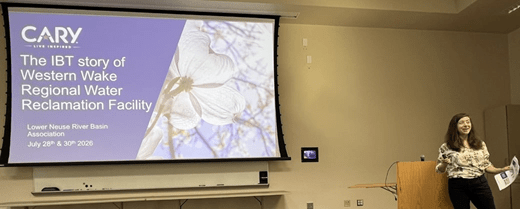
At the request of the Lower Neuse Basin Association (LNBA), Water Resources Manager Sarah Braman presented Cary’s approach to Interbasin Transfer (IBT) planning during the association’s annual training event. LNBA supports water quality monitoring throughout the Neuse River Basin, from Falls Lake Dam to the Neuse Estuary, and brings together utilities to share information and best practices. The presentation provided an overview of the laws, requirements, and decades-long history of Cary’s IBT certificates, highlighting the long-term planning that helps ensure a reliable water supply while meeting state regulatory requirements. The two-day training provided continuing education credits for wastewater operators maintaining their professional licenses.
American Revolution Experience Recap

The American Revolution Experience traveling exhibit welcomed 625 visitors during its eight-day stay at the Gathering House in Downtown Cary Park from July 18 – 25. Produced by the American Battlefield Trust and the Daughters of the American Revolution (DAR) and sponsored locally by the Asbury Station chapter of the DAR, the exhibit featured interactive displays exploring the people and events of the American Revolution. More than 100 people attended the opening day on July 18, including members of the DAR, Friends of the Page-Walker, and a historical interpreter portraying General George Washington. Throughout the exhibit, visitors signed the “Declaration of Attendance,” posed for photos with George and Martha Washington photo cutouts, and enjoyed hands-on activities for children.
Important Dates
Parks, Recreation, and Cultural Resources Advisory Board
Monday, August 3, 5:15 p.m.
Information Services Advisory Board
Monday, August 3, 6:00 p.m.
Human Relations, Inclusion, & Diversity Advisory Board
Tuesday, August 4, 6:00 p.m.
Senior Advisory Board
Wednesday, August 5, 12:00 p.m.
Virtual Neighborhood Rezoning Meeting
Wednesday, August 5, 6:30 p.m.
Dashboard of Recommendations by Cherry Bekaert, OSA, and Womble Bond Dickinson
The latest updates on the Town’s actions in response to recommendations from Cherry Bekaert, the Office of the State Auditor (OSA), and Womble Bond Dickinson are available on the Town’s Moving Forward Dashboard:
https://www.carync.gov/connect-engage/newsroom/bottom-line/moving-forward-dashboard
You can also sign up to receive notifications whenever the dashboard is updated.
Council Initiated Items
The council has a process that allows members to introduce items for discussion at meetings, often leading to further action. Given the recent increase in these requests, I will begin sharing them here along with my perspective on their pros and cons.
Temporary moratorium on Data Centers
This proposal was submitted by Mayor Pro-Tem Bush, and I provided the second. It was brought up at the May 28th Council meeting. It will come back to council after the staff has gathered information.
Data centers are centralized facilities that house IT equipment for storing, processing, and distributing massive amounts of data. While they are the vital backbone of the modern internet and AI, they also pose notable environmental and community challenges by requiring massive amounts of electricity and millions of gallons of water. This proposal would direct staff to put a moratorium on data center approvals.
PROS:
- They generate significant long-term property and sales tax revenue for local municipalities, often offsetting the need to raise taxes on residents.
- They provide the essential computing power required to run the cloud, stream media, and train heavy AI models.
- Modern facilities offer unparalleled uptime, physical security, and disaster recovery protections for critical business information.
- Unlike large manufacturing plants or warehouses, operational data centers generate minimal daily traffic and produce very little localized air pollution.
CONS:
- We may not have authority to permanently prohibit them.
- They demand immense amounts of electricity and millions of gallons of water for cooling, which can strain local utility grids and drive-up energy costs for surrounding communities.
- Unless heavily offset by renewable energy sources, heavy reliance on power can prolong the use of fossil fuel plants and contribute to electronic waste.
- The constant operation of high-powered cooling fans and backup generators can create significant, round-the-clock noise disturbances for nearby residents.
- While construction creates many temporary jobs, fully operational data centers typically require very few on-site staff, delivering fewer permanent local jobs than other large-scale developments.
Partnering with the school board to pilot school zone safety improvements
This proposal was submitted by Council Member Bansal, and I provided the second. It was brought up at the May 28th Council meeting.
Several schools in Cary, particularly middle schools and high schools, are experiencing transportation safety concerns on and around school property. While the schools are responsible for transportation operations on campus and NCDOT oversees roadway infrastructure decisions, progress on improvements has been slow and resident complaints have continued to increase. This proposal would direct staff to work collaboratively with the schools on programs and strategies to help address these concerns.
PROS:
- Allows the Town to take a more proactive role, even when we are not the primary decision-maker.
- Responds to growing community concerns regarding school transportation safety.
CONS:
- The Town is currently understaffed, so this effort could require shifting staff resources away from other projects.
- Potential solutions could result in additional costs to taxpayers if Cary contributes funding toward implementation.
E-Bike Safety
This proposal was submitted by Council Members Bansal and Richards and presented at the April 16th meeting. It was part of our June 23rd work session.
The council initially launched a pilot program in June 2022 to allow e-bikes. After a one-year trial period, the program was made permanent, with a posted speed limit of 15 mph on greenways. Recently, however, there have been complaints that e-bikes, scooters, and similar devices are traveling at excessive speeds and creating potentially hazardous conditions.
PROS:
- We are listening to our citizens’ complaints.
- Preventing e-bikes and scooters will possibly make greenways safer.
CONS:
- There is basically no way to enforce an ordinance that has e-bikes or not.
- Any enforcement effort would require additional officers and officers’ time. We are currently underfunding officers and require overtime to maintain existing levels of service.
- We are revisiting a decision that was made after a one-year trial and review of data.
Council will vote on a draft ordinance of this later this year.
Smoke Free Ordinance
This proposal was submitted by Mayor Pro-Tem Bush and Council Member Craig and presented at the April 16th meeting. It was part of our June 23rd work session.
PROS:
- Eliminates toxic secondhand smoke.
- Current ordinance does not match state law and Raleigh/Wake ordinance.
CONS:
- Any enforcement effort would require additional officers and officers’ time. We are currently underfunding officers and require overtime to maintain existing levels of service.
Council will vote on options to add to the current ordinance later this year.
Affordable Housing on Old Library Site
This proposal, submitted by Mayor Pro Tem Bush and Council Member Bansal, would place a podium-style parking deck with affordable housing on the former library site. This has yet to be scheduled for a meeting agenda.
PROS:
- Adds parking across from Downtown Cary Park.
- Create affordable housing units in the downtown area.
CONS:
- May underutilize one of the municipality’s most valuable properties. Downtown Cary Park generates approximately $16 million annually in economic impact, and this site could represent an opportunity for a more transformative use.
- The town has already invested millions in renovating the Ivey-Ellington House, positioning this area as a premier destination.
Mayor’s Mailbox
- A continuation of hate via emails, social media, etc. about what was reported by the State Auditor. Most believe I was knowledgeable, compliant, and/or responsible even if I knew nothing. (No, I was the whistleblower) I will not post any of the nastiness. I am sure it is easy to find with a search.
- Accusations that the town is not being transparent with PCards since they are numbered and no names are associated with them. (The Mayor and Council were not involved in the PCard transactions or in monitoring their use. That will, of course, change moving forward. The OSA assigned the PCard numbers, and I can only assume it maintains the records identifying the individuals associated with each card.)
- In their continued effort to discredit me, undermine my character, and destroy my credibility, a member of the television media came to the town hall and asked to interview me in my office. (The mayor does not have an office at Town Hall, and neither the mayor nor the Council has had office space there for about a decade. The reason is straightforward: under the council-manager form of government, elected officials are intentionally separated from the day-to-day operations of the municipality. Having offices at Town Hall could create the impression that the Mayor and Council are involved in administrative functions, when that is not their role. The Mayor and Council are responsible for establishing policy, while the Town Manager and staff are responsible for carrying out those policies and managing daily operations. In light of recent events, the Council will certainly consider additional policies and oversight measures to strengthen accountability and monitoring. I would also encourage members of the television media to become more familiar with the council-manager form of government. A better understanding of how this system is structured may help answer many of the questions they are asking.)
- Several encouraging remarks:
“it is clear the vocal minority is still energized about past issues that a lot of objective work indicates were driven primarily by manipulative and self-serving actions of Sean Stegall”
…
“Cary has already taken many appropriate actions to prevent a similar situation from occurring again.”
…
“a commitment to additional governance improvements which will likely make us best-in-class in use of our mandated council-manager form of government.”
…
“past spending abuse is highly disturbing to everyone, but in the big picture it constitutes a very small percentage of the Cary budget and is not the driver behind the latest tax increase”
- A request to vote no on WakeMed being sold. (We are not the decision makers)
- Several thank and hate emails about the RHA decision on Amberwood.
- A complaint about the proposed Pittard Sears rezoning and annexation.
- A complaint about the proposed Sherwood Forest Place rezoning. (Early in a multi-month process. Council does not have a staff report)
Next Week
Next week’s activities include staff meetings, and the Cary Chamber Leadership dinner. My next post will be on Sunday, August 9th, 2026. Please send all Town of Cary questions or comments to Harold.Weinbrecht@carync.gov. Note that all email sent to me in my role as mayor is a public document.
How Cary Government Works
Cary’s government, like most cities in North Carolina and most mid-sized cities in the U.S., uses a council–manager form of government. This system works a lot like a company, but for local government. Residents elect a council and a mayor, who set policy by passing laws, approving the budget, and guiding the town’s overall priorities. The council then hires a professional manager to run the town’s day-to-day operations.
Think of it like a company: the council acts like a board of directors, making policy and representing the public, while the city manager acts like a CEO, overseeing all departments, such as finance, public works, police, and fire, and managing town staff. The mayor leads council meetings, represents the town publicly, and has limited executive authority. While the council and mayor make policy decisions and receive regular reports, they usually see only high-level summaries rather than the detailed inner workings of each department.
In short, just as a board hires a CEO to run a company, Cary’s council hires a manager to run the town, ensuring professional management while elected officials focus on big-picture decisions and community priorities.
You can find additional information about how Cary’s government works on the town’s website here.
Purpose of this Blog
It is my hope that this blog will provide insight not only into who I am meeting with on behalf of the Town, but also the topics we discuss. I believe strongly in open and transparent government. This blog is one of several initiatives I implemented when I became mayor in 2007 to make the governmental process more accessible to our citizens.
This blog is written with sincerity, honesty, and a commitment to accuracy so our constituents can better understand the work we do. After all, we work for them!

