
By-Right Residential Development
A recent law enacted by the legislature will allow redevelopment without council approval. Here is staff’s explanation of the new law:
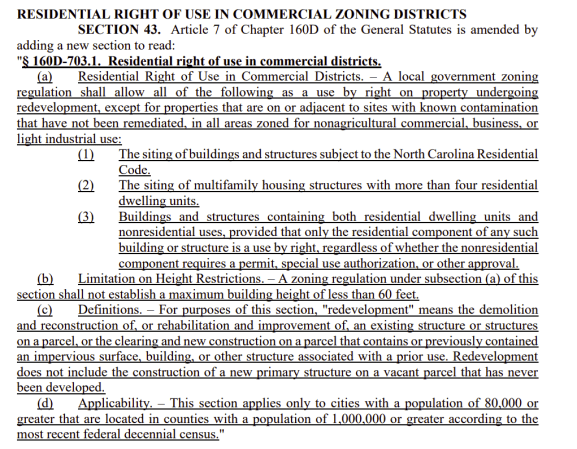
Interim Guidance for the Application of Section 43 of North Carolina Session Law 2026-59 (G.S. 160D-703.1), the Regulatory Reform Act of 2026: Residential Right of Use in Commercial Zoning Districts
On August 11, 2026, Governor Josh Stein signed Senate Bill 455, thus enacting Session Law 2026-59, commonly referred to as the Regulatory Reform Act of 2026. Section 43 of the act, Residential Right of Use in Commercial Zoning Districts, is codified as G.S. 160D-703.1 and took effect August 11, 2026. It applies to municipalities with a population of 80,000 or greater located in counties with a population of 1,000,000 or greater according to the most recent federal decennial census. Only three jurisdictions meet both thresholds: Charlotte, Raleigh, and Cary.
Section 43 requires these cities to allow the following as uses by right on property undergoing redevelopment and located in areas currently zoned for nonagricultural commercial, business, or light industrial use: buildings subject to the North Carolina Residential Code; multifamily buildings with more than four dwelling units; and the residential portion of mixed-use buildings. Properties on or adjacent to sites with known contamination that has not been remediated are excluded from these requirements. If all criteria are met, when commercial, business, or light industrial properties are redeveloped, the owner can build almost any type of housing without needing rezoning from Cary.
“Redevelopment” is defined as “the demolition and reconstruction of, or rehabilitation and improvement of, an existing structure or structures on a parcel, or the clearing and new construction on a parcel that contains or previously contained an impervious surface, building, or other structure associated with a prior use.” The term does not include “the construction of a new primary structure on a vacant parcel that has never been developed.”
The statute also prohibits local government zoning regulations from limiting building height on these sites to less than 60 feet. The full text of Section 43 is included in attachment 1.
This guidance, effective immediately, outlines the process through which Cary will apply the statute to eligible development proposals. To further clarify the application of Section 43, Land Development Ordinance (LDO) amendments may be needed. Such amendments, once adopted, will supersede and replace this guidance. This guidance may also be updated from time to time as determined by the Planning Director.
1.Optional Eligibility Determination: Property owners seeking redevelopment through Section 43 may request a property eligibility determination. This request must be submitted in writing and must identify the parcel(s) intended for redevelopment, include the property deed, disclose any known contamination on or adjacent to the parcel and the status of any remediation by owner affidavit and include a narrative detailing the proposed use and existing conditions. A property owner may do this in conjunction with the pre-application conference or in advance. The Planning Director will issue a written determination within thirty days of receipt of a complete submission that either confirms or denies the parcel’s eligibility for by-right redevelopment under Section 43.
2. Required Development Review Committee Pre-Application Conference: As required by Section 3.1.5 of Cary’s LDO for all development plan applications, an applicant desiring to redevelop pursuant to Section 43 must schedule a pre-application conference prior to submitting a development plan for review. During the pre-application conference, staff will evaluate the parcel for Section 43 eligibility, if not requested in advance. For properties eligible for Section 43 by-right development, staff will provide information on the development standards and requirements for developing the property, based on the current zoning of the property, except that the maximum building height shall be at least 60 feet.
Section 43 does not provide guidance on the residential density standard to apply to these properties. Many of Cary’s zoning districts that permit nonagricultural commercial, business, or light industrial uses do not contain a residential density standard, because residential use was intended to be prohibited in those areas. For purposes of implementing Section 43, which now requires Cary to permit residential uses in those areas, staff will proceed as follows: If the current zoning for the property contains a residential density standard, that standard will control. If the current zoning for the property does not contain a residential density standard, Cary currently has no inherent authority to require a residential density standard in that zoning district absent an amendment to the LDO. Affected municipalities were given no lead time to implement needed LDO amendments to incorporate Section 43 as the legislation became effective immediately upon passage; those amendments are in development.
3. Required Development Plan Submittal: After completing a pre-application conference, a property owner may file a development plan. The development plan must meet the development standards of the property’s current zoning district and all other applicable LDO standards, except that the maximum building height shall be 60 feet and be accompanied by a statement attesting to no material changes since the pre-application conference that would change the parcel’s eligibility determination. Upon receipt of a complete development plan submittal, staff will route the plan through the applicable development plan review process.
The town’s information on this policy can be found on our webpage here.
SAS Pro-Am
Cary hosted the 26th annual SAS Championship at Prestonwood Country Club this week. The tournament is the final event on the PGA TOUR Champions schedule before the playoffs begin.
As is tradition, Cary’s mayor participates in the Pro-Am event. On Wednesday, I had the pleasure of playing with professional golfer Heath Slocum, and on Thursday, I enjoyed a round with South African professional Darren Fichardt. Both were excellent players and wonderful company.
My foursome also included former Town Council member Jack Smith and former Cary Chamber of Commerce President Howard Johnson. Since I’m not much of a golfer, our team wasn’t exactly in contention, but we had a great time enjoying the experience and fellowship.
On Thursday afternoon, I also filmed a brief commercial promoting Cary, continuing a tradition from previous years. Here’s the script I used this year:
“Hello from Cary, North Carolina, where we’re proud to once again host the 2026 SAS Championship at beautiful Prestonwood Country Club.
This great tournament is just one of many national and international amateur, collegiate, and professional sporting events we host in Cary at our world-class venues. They’re helping make Cary and the surrounding Triangle rank among the top sports and visitor destinations in the nation.
Please accept my personal invitation to come visit and see why Cary is consistently named one of the best places to live, work, and play in America.”
The commercial aired on the Golf Channel alongside other advertisements highlighting Cary. It was another great opportunity to showcase our community, celebrate our outstanding sporting venues, and invite viewers from across the country to experience all that Cary has to offer.
Council Work Session Recap
The Town Council held a work session Thursday evening to discuss the Historic Preservation Master Plan, potential additional work for the town’s external audit firm, Cherry Bekaert, the Ederlee Drive rectangular rapid-flashing beacon (RRFB), and early voting.
Historic Preservation Master Plan
One of the key topics was the upcoming update to Cary’s Historic Preservation Master Plan. The update is funded in the FY2027 budget. Here are some of the highlights from the discussion:
History and Accomplishments:
- Early preservation efforts: Cary’s foundational historic preservation work began before 2010.
- Historic Preservation Master Plan: Created in 2010, the plan formally established historic preservation as an official program area and dedicated staff resources to preservation efforts.
- Historic Preservation Commission (HPC): In 2014, Cary withdrew from the Wake County Historic Preservation Commission and adopted ordinances to establish its own commission. The local program was certified in 2017 and incorporated into the Cary Community Plan.
- Historic property investments: Restoration costs for several of Cary’s historic properties include $1.3 million for the Page-Walker, $13 million for the Cary Arts Center, and $6.1 million for the Cary Theater. Private fundraising contributed to the Page-Walker restoration.
- 2019 voter-approved bonds: The bonds supported the relocation and restoration of the Ivey-Ellington House, along with investments in other historic properties:
- A.M. Howard Farmhouse: $359,471
- C.F. Ferrell Store: $58,518
- Barnabus Jones Farmstead: $341,388
Nancy Jones House:
Cary’s work to preserve the Nancy Jones House has progressed through several milestones:
- 2019: Cary took ownership of the property.
- 2021: The house was relocated.
- 2022: Its continued listing on the National Register of Historic Places was confirmed.
- 2023: The house was dedicated as an Historic Cary Landmark.
Cary is currently working with the Friends of the Page-Walker to explore public-private partnership opportunities to fund the restoration of the Nancy Jones House.
Cary-Owned Historic Landmarks:
Cary owns several historic landmarks and properties, including:
- Page-Walker
- Cary Arts Center
- Cary Theater
- Mitchell’s Pharmacy building
- Sam Jones House
- Ivey-Ellington House
- Nancy Jones House
- Jones Bartley Farm
- A.M. Howard Farm
- Good Hope Farm
- C.F. Ferrell Store
- Markham-Ferrell Cabin
A consultant to update the Historic Preservation Master Plan is expected to be hired in late fall or early winter. Public engagement and plan development are anticipated to begin next spring and summer.
Cherry Bekaert: Potential Additional Audit Services
Council reviewed options for additional work from the town’s external audit firm, Cherry Bekaert. The firm presented four areas of focus for consideration:
- Policy and Procedure Evaluation and Update: $5,000–$8,000 per policy or procedure
- Financial Operations Health Check: $10,000–$12,000
- Financial Dashboarding: $17,000–$25,000
- Fraud Prevention and Mitigation: $20,000–$30,000
These areas of focus will also be considered as part of the work of Cary’s new internal auditor. The position, funded in this year’s budget, is currently in the hiring phase.
Based on Council’s feedback, staff will bring forward a report for a mid-year appropriation. Cherry Bekaert anticipates beginning work on the selected focus area or areas after completing the FY2026 financial audit.
Ederlee Drive Pedestrian Safety Improvements
Rectangular rapid-flashing beacons (RRFBs) are scheduled for installation on Ederlee Drive next week. The work will include replacing the existing crosswalk signs and adding advance warning signs with LED enhancements.
These improvements are an interim safety measure that will remain in place until NCDOT installs a pedestrian hybrid beacon, which is expected in a couple of years.
Early Voting
Early voting is underway, with 18 locations available across the area. Two locations are in Cary:
- Cary Senior Center
- Herbert C. Young Community Center
Residents can use either Cary location to cast their ballots during the early voting period.
Folds of Honor
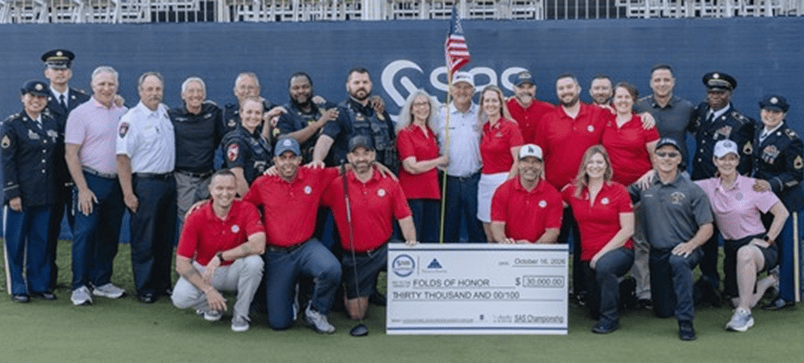
A special Folds of Honor ceremony was held to kick off the 2026 SAS Championship golf tournament, featuring a flyover by two vintage aircraft. The ceremony honored the sacrifices of our military service members, first responders, and their families while celebrating the mission of Folds of Honor: providing educational scholarships to the spouses and children of America’s fallen and disabled military service members and first responders.
I was honored to offer a few remarks on behalf of the Cary Town Council and our community:
“Good morning, everyone, and welcome to Cary!
On behalf of the Cary Town Council and the entire community of Cary, it’s an honor to be with you as we begin the 26th SAS Championship and celebrate its partnership with Folds of Honor, an organization that embodies service, sacrifice, and hope.
The SAS Championship is about more than great golf. It is about community and the power of bringing people together around a shared purpose. And today, we want to make sure that the sacrifices made by our military, first responders, and their families are never forgotten.
This ceremony gives us an opportunity not only to say thank you, but to put that gratitude into action. Through the work of Folds of Honor, we can help open doors, create opportunities, and invest in the future of deserving families.
To all of our veterans, active-duty service members, first responders, military and first responder families, and scholarship recipients: thank you. We honor you, we appreciate you, and we will never forget your sacrifices.
Thank you for being here and thank you for supporting the SAS Championship and the mission of Folds of Honor.
God bless our military families, God bless our first responders and their families, God bless our community, and God bless the United States of America! Thank you.”
The ceremony also included remarks from a colonel representing Fort Bragg, SAS, and Folds of Honor, followed by a moving rendition of the national anthem performed by an SAS employee. Three ceremonial tee shots marked the occasion, and SAS presented Folds of Honor with a generous $30,000 donation in support of its mission. The event concluded with everyone gathering for photos to commemorate this meaningful celebration.
Folds of Honor is an incredible organization that makes a lasting difference in the lives of military and first responder families. I’m grateful to have been part of this special event and encourage anyone who feels inspired by its mission to consider supporting this outstanding organization.
Town Manager’s Report
Council,
As mentioned at last night’s work session, staff will begin installing a Rectangular Rapid Flashing Beacon (RRFB) at the Ederlee Drive crosswalk near Regency Parkway. This work includes replacing the existing crosswalk and advance warning signs with LED-enhanced signs and RRFB devices to improve visibility for drivers. This is an interim improvement we are making with NCDOT’s support until they start their permanent Pedestrian Hybrid Beacon (PHB) project. NCDOT currently anticipates advertising that project for bids in October 2028. I appreciate our staff working with NCDOT to get these interim improvements in place.
I’ll be spending part of my weekend at the NC State Fair helping with the goat shows. It’s something I always enjoy, and I’m looking forward to being part of the fun again this year.
I hope you all get to do something fun this weekend as well!
Russ Overton
Interim Town Manager
Moving Forward Dashboard
Cary has updated its Moving Forward Dashboard to reflect progress through this week, changing the status of one recommendation to Complete (OSA 09) and one recommendation to Development (WBD 07).
Residential By-Right Information Web Page
Following Council’s request at the October 8 work session, staff created a webpage to help residents understand the implications of the new statute allowing by-right residential development in Cary. The page provides information for residents and property owners pursuing redevelopment under the statute. Cary’s Interim Guidance Document is also available on the webpage.
Public Works Hosts Annual Snow Rodeo
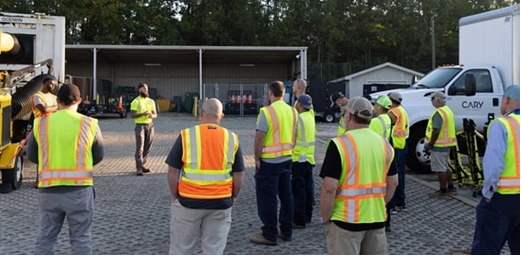
Today, the Public Works A-Team held its annual Snow Rodeo, bringing together more than 300 team members for hands-on training ahead of the loose leaf collection season, which begins November 2, and in preparation for possible winter weather. The event included safety training, equipment testing, and route familiarization, as well as interdepartmental coordination to ensure operational readiness. This year’s event featured a driving simulator that replicates real-life inclement-weather driving situations, such as snow and ice, to strengthen drivers’ skills and preparedness.
Regional Water Supply Plan Finalized
Last Friday, the Triangle Water Supply Partnership (TWP) presented the final Regional Water Supply Plan (RWSP), developed with guidance from a technical committee chaired by Cary Water Resource Manager Sarah Braman, to a stakeholder group that included the North Carolina Division of Water Resources, the United States Army Corps of Engineers (USACE), and the North Carolina Policy Collaboratory. The collaboratory will use the RWSP as a basis for the high-growth study recently commissioned by the General Assembly. The RWSP incorporates the forecast from Cary’s Long Range Water Resource Plan (LRWRP) and aligns with future water supply strategies.
Enbridge Presents Police and Fire Donation Checks
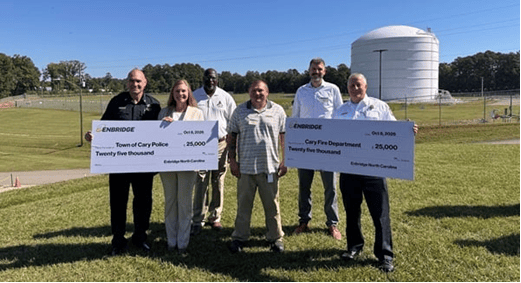
Last week, Enbridge Gas North Carolina, formerly Dominion Energy, presented the Police and Fire departments with $25,000 donations in recognition of the company’s 50 years of operations in Cary. These funds will be used to strengthen emergency preparedness and response capabilities in the event of an incident at an Enbridge facility. Council will receive a staff report to recognize these funds in the near future.
My Tree, Our Tree Adds 600 Native Trees to Cary’s Canopy
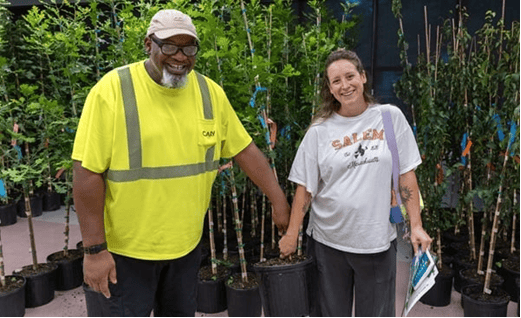
Cary’s fall My Tree, Our Tree distribution event took place Saturday, distributing 600 native trees to residents. Since launching in 2021, the program has added 8,298 trees to Cary’s urban forest. The event also offered opportunities to connect with environmental experts and learn about proper planting techniques, tree care, native plants, pollinators, and Cary’s environmental programs and services, empowering residents to help grow a greener, healthier Cary.
Fall Litter Sweep Complete
Nearly 30 volunteers participated in Cary’s Fall Litter Sweep on Saturday, removing approximately 360 pounds of litter from public lands. Hosted in partnership with Wake County’s Big Sweep and under the guidance of the Keep America Beautiful national non-profit program, this annual service-learning event has helped keep Cary clean and green for more than 15 years. In addition to bringing residents together to protect the environment, the event helps preserve North Carolina’s waterways and supports Cary’s water quality goals.
Hum Sub Diwali Recap
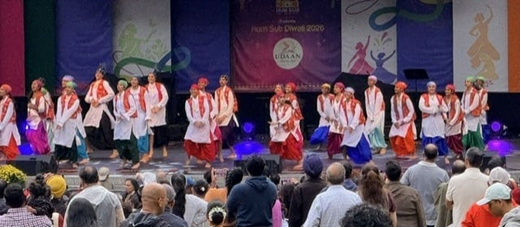
Hum Sub Diwali returned to Koka Booth Amphitheatre on Saturday for its 26th year, bringing together approximately 8,000 attendees for a celebration of Indian culture. More than 1,200 performers took the stage throughout the day with traditional dance and music, while food vendors, cultural exhibits, and shopping booths filled the venue. The evening featured a headline performance by Vidya Vox and Rohith Jayaraman, accompanied by a live band, before a fireworks finale closed out the celebration.
Applause! Cary Youth Theatre’s Twelve Night
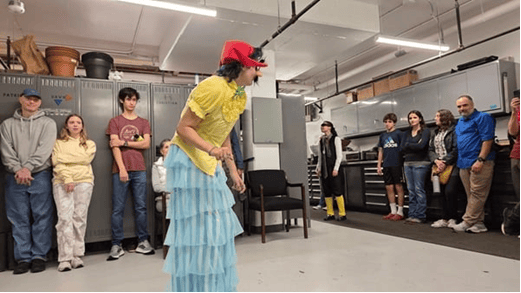
Applause! Cary Youth Theatre’s Shakespeare Live series presented Twelfth Night at Downtown Cary Park on Sunday. Originally planned as an outdoor performance, the show moved to the Gathering House due to thunderstorms. When conditions escalated to a tornado watch, park staff and the artistic team quickly relocated nine teenage performers, crew members, and 49 audience members to the park’s basement, where the cast finished the play. Thanks to the flexibility and quick coordination of staff and performers, the show went on despite the unexpected circumstances.
Barkitecture at Downtown Cary Park
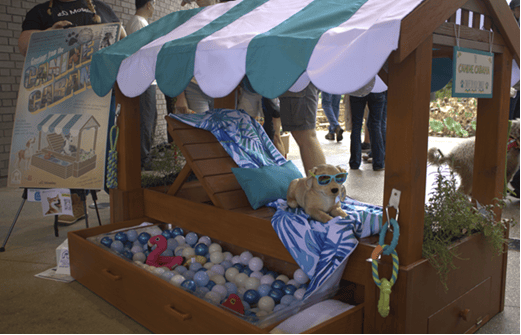
On Saturday, Downtown Cary Park hosted Triangle Barkitecture, welcoming more than 1,500 attendees for a celebration of pets, creativity, and community. The event featured more than 20 custom pet structures created by local architects and designers, along with adoptable animals from more than a dozen rescue organizations. Visitors enjoyed a kitten cuddle room, Howl-o-Ween pet costume contest, and local vendors. An auction of custom pet structures raised $11,000 to support local animal rescue organizations.
Virtual Neighborhood Rezoning Meeting – November 4
The following neighborhood meeting will be held on Wednesday, Nov. 4, at 6:30 p.m.
For more information and to register, please visit the Virtual Neighborhood Rezoning Meeting page.
Important Dates
Public Art Advisory Board
Wednesday, October 21, 6:15 p.m.
Council Committee
Thursday, October 22, 5:15 p.m.
Town Council Meeting
Thursday, October 22, 6:30 p.m.
Mayor’s Mailbox
- A question about when the lakes would be filled by the Twin Lake Rehabilitation. (Waiting for approval from NC Dam Safety)
- A complaint about the White Oak Greenway closure.
- A complaint about “obstruction” at Cary Parkway and Tarbert Drive.
- A complaint about the bridge replacement at Walnut Street Park “for a vanity project is not a constructive use of taxpayer funds”.
- Data on a smoke free ordinance provided by the American Heart Association.
- A complaint about the lack of handicap spaces at the Herb Young Community Center.
- A request to have “Wands of Wonder” again at Downtown Cary Park.
- A complaint about the rezoning proposal at Trenton Road. (This now qualifies with the new state legislation that allows building by right and eliminates a council decision)
- Thank you for graffiti removal.
- A request for an app for an “urban tree adoption”
Next Week
Next week’s activities include staff meetings, a Wake County Mayors Association meeting, a GRCVB (Greater Raleigh Convention and Visitor Board) meeting, a Muffins with the Mayor event, a CAMPO meeting, a Recommendations Committee meeting, and a council meeting.
My next post will be on Sunday, October 25th, 2026. Please send all Town of Cary questions or comments to Harold.Weinbrecht@carync.gov. Note that all emails sent to me in my role as mayor are public documents.
Dashboard of Recommendations by Cherry Bekaert, OSA, and Womble Bond Dickinson
The latest updates on the Town’s actions in response to recommendations from Cherry Bekaert, the Office of the State Auditor (OSA), and Womble Bond Dickinson are available on the Town’s Moving Forward Dashboard. There are 39 recommendations in total. This link gives the progress on each of those recommendations:
https://www.carync.gov/connect-engage/newsroom/bottom-line/moving-forward-dashboard
You can also sign up to receive notifications whenever the dashboard is updated.
Council Initiated Items
The council has a process that allows members to introduce items for discussion at meetings, often leading to further action. Given the recent increase in these requests, I will begin sharing them here along with my perspective on their pros and cons.
Partnering with the school board to pilot school zone safety improvements
This proposal was submitted by Council Member Bansal, and I provided the second. It was brought up at the May 28th Council meeting.
Several schools in Cary, particularly middle schools and high schools, are experiencing transportation safety concerns on and around school property. While the schools are responsible for transportation operations on campus and NCDOT oversees roadway infrastructure decisions, progress on improvements has been slow and resident complaints have continued to increase. This proposal would direct staff to work collaboratively with the schools on programs and strategies to help address these concerns.
PROS:
- Allows the Town to take a more proactive role, even when we are not the primary decision-maker.
- Responds to growing community concerns regarding school transportation safety.
CONS:
- The Town is currently understaffed, so this effort could require shifting staff resources away from other projects.
- Potential solutions could result in additional costs to taxpayers if Cary contributes funding toward implementation.
E-Bike Safety
This proposal was submitted by Council Members Bansal and Richards and presented at the April 16th meeting. It was part of our June 23rd work session.
The council initially launched a pilot program in June 2022 to allow e-bikes. After a one-year trial period, the program was made permanent, with a posted speed limit of 15 mph on greenways. Recently, however, there have been complaints that e-bikes, scooters, and similar devices are traveling at excessive speeds and creating potentially hazardous conditions.
PROS:
- We are listening to our citizens’ complaints.
- Preventing e-bikes and scooters will possibly make greenways safer.
CONS:
- There is basically no way to enforce an ordinance that has e-bikes or not.
- Any enforcement effort would require additional officers and officers’ time. We are currently underfunding officers and require overtime to maintain existing levels of service.
- We are revisiting a decision that was made after a one-year trial and review of data.
Council will vote on a draft ordinance of this later this year.
Smoke Free Ordinance
This proposal was submitted by Mayor Pro-Tem Bush and Council Member Craig and presented at the April 16th meeting. It was part of our June 23rd work session.
PROS:
- Eliminates toxic secondhand smoke.
- Current ordinance does not match state law and Raleigh/Wake ordinance.
CONS:
- Any enforcement effort would require additional officers and officers’ time. We are currently underfunding officers and require overtime to maintain existing levels of service.
The council did not have enough votes to amend the current ordinance at the October 8th meeting. It will return for another vote at a future meeting.
Affordable Housing on Old Library Site
This proposal, submitted by Mayor Pro Tem Bush and Council Member Bansal, would place a podium-style parking deck with affordable housing on the former library site. This has yet to be scheduled for a meeting agenda.
PROS:
- Adds parking across from Downtown Cary Park.
- Create affordable housing units in the downtown area.
CONS:
- May underutilize one of the municipality’s most valuable properties. Downtown Cary Park generates approximately $16 million annually in economic impact, and this site could represent an opportunity for a more transformative use.
- The town has already invested millions in renovating the Ivey-Ellington House, positioning this area as a premier destination.
How Cary Government Works
Cary’s government, like most cities in North Carolina and most mid-sized cities in the U.S., uses a council–manager form of government. This system works a lot like a company, but for local government. Residents elect a council and a mayor, who set policy by passing laws, approving the budget, and guiding the town’s overall priorities. The council then hires a professional manager to run the town’s day-to-day operations.
Think of it like a company: the council acts like a board of directors, making policy and representing the public, while the city manager acts like a CEO, overseeing all departments, such as finance, public works, police, and fire, and managing town staff. The mayor leads council meetings, represents the town publicly, and has limited executive authority. While the council and mayor make policy decisions and receive regular reports, they usually see only high-level summaries rather than the detailed inner workings of each department.
In short, just as a board hires a CEO to run a company, Cary’s council hires a manager to run the town, ensuring professional management while elected officials focus on big-picture decisions and community priorities.
You can find additional information about how Cary’s government works on the town’s website here.
Purpose of this Blog
It is my hope that this blog will provide insight not only into who I am meeting with on behalf of the Town, but also the topics we discuss. I believe strongly in open and transparent government. This blog is one of several initiatives I implemented when I became mayor in 2007 to make the governmental process more accessible to our citizens.
This blog is written with sincerity, honesty, and a commitment to accuracy so our constituents can better understand the work we do. After all, we work for them!

