
US 64 Meeting
Monday afternoon, I joined elected officials and staff from Cary and Apex for a presentation by NCDOT on the proposed US 64 Highway Improvements project, which will extend from US 1 to Laura Duncan Road.
The project design is currently 25% complete and includes several significant improvements:
- Additional capacity: One additional travel lane in each direction along US 64.
- New interchanges and bridges: New interchanges with bridges at Laura Duncan Road and Lake Pine Drive, along with new bridges over US 64 at Shepherds Vineyard Drive and Edinburgh Drive.
- Intersection improvements: Modifications to intersections between US 1 and Lake Pine Drive and replacement of the CSX railroad bridge.
- Local road improvements: Improvements to Laura Duncan Road, Shepherds Vineyard Drive, Lake Pine Drive, and Edinburgh Drive, including new sidewalks and multi-use paths.
- Access changes: Some roads, including AutoPark Boulevard, will no longer have direct access to US 64.
- Noise mitigation: Noise walls are planned in several locations, including along MacGregor Downs. No noise wall is planned between Edinburgh Drive and US 1 because US 64 will be lowered in that section.
One significant impact of the project will be property acquisition. NCDOT currently anticipates acquiring 2 residential properties and 17 commercial properties, with the process expected to begin next year. NCDOT indicated that these numbers are unlikely to change.
Construction is expected to begin in 2031 and will be completed in phases.
The overall project has an estimated cost of over $304 million. Work on the CSX railroad bridge is expected to begin ahead of the roadway improvements, that is a separate project with an estimated cost of more than $38 million.
This is a significant project that will impact our communities, and it is important for residents and businesses to understand what is being proposed.
You can find project details, plans, and additional information on the NCDOT website:
https://www.ncdot.gov/projects/us-64-apex-cary.
Council Work Session on Fund Balance and Recommendations
At Monday night’s work session, the Council discussed the Town’s fund balance policy, the upcoming meeting schedule, and recommendations from the Council Recommendations Committee.
Fund Balance Policy Discussion
The discussion highlighted the primary purposes of fund balance, which include providing cash flow to meet short-term needs, serving as a financial safety net for unexpected events, and funding one-time capital expenses without relying on debt.
Cary has five categories of fund balance:
- Nonspendable: Resources that cannot be spent, such as inventory and prepaid expenses.
- Restricted: Resources legally restricted for specific purposes, such as those required by state statute or designated through grants.
- Committed: Resources set aside through formal action, such as decisions made by Council.
- Assigned: Resources intended for specific purposes, including reserves for small claims and workers’ compensation.
- Unassigned: Resources that have no restrictions or specific designations.
Of these five categories, Nonspendable, restricted, and committed fund balances are considered unavailable, while assigned and unassigned fund balances are considered available.
Current Fund Balance Policy
Under the current Fund Balance Policy 175, the Town’s total fund balance must be maintained at a minimum of 33.33% of budgeted General Fund expenditures, equivalent to approximately four months of operating expenses. General Fund expenditures include total expenditures and debt service but exclude other financing sources and uses.
The Council also discussed improving the frequency and transparency of fund balance reporting. Quarterly reports to Council would include:
- Actual fund balance compared to the policy target.
- Forecasted year-end fund balance.
- Key revenue and expenditure risks.
- Known one-time funding needs.
An annual review of the policy would provide an opportunity to reassess risk assumptions, review the reserve target and minimum threshold, consider current economic conditions, and make updates as needed.
Key Policy Decisions Moving Forward
Several key considerations will help guide potential changes to the fund balance policy:
- Fund Balance Measurement: Determine whether the policy should be based on total fund balance, available fund balance, or unassigned fund balance.
- Budget Basis: Consider using current-year budgeted expenditures for the current year and budgeted General Fund and other fund expenditures in subsequent years.
- Reserve Percentage: The current reference point for the reserve target is 33.33%.
One option receiving particular attention was the use of unassigned fund balance as the primary measure for the operating reserve. This approach focuses on the remaining General Fund resources that are not classified as Nonspendable, restricted, committed, or assigned.
Using unassigned fund balance could provide several benefits:
- Reduce the risk of counting resources already dedicated to other purposes toward the operating reserve requirement.
- Establish a clearer connection between the reserve target and the Town’s ability to respond to revenue timing gaps, emergencies, and economic disruptions.
- Strengthen accountability by ensuring that decisions to assign or commit resources are visible and do not inadvertently inflate the core reserve measurement.
Next Steps
Additional options for potential changes to the Fund Balance Policy will be presented to Council during a December work session. The FY 2026 audit results will also be reviewed during that session. Council is scheduled to consider and approve a revised Fund Balance Policy at a January Council meeting.
The next item of business during the work session was a review of the council calendar. The council approved two schedule changes. The regular council meeting originally scheduled for January 28 will be moved to January 26, and the work session scheduled for January 26 will be cancelled. Additionally, the council meeting and work session originally scheduled for March 11 will both be moved to March 9.
The final topic of the work session was a presentation from the Recommendations Committee to gather feedback from Council on several proposed policy recommendations. The committee consists of myself, Council Member Kohn-Johnson, and Council Member Richards.
The committee presented the following information and recommendations for Council consideration:
Existing Ethics Policy
- The Town already has an ethics policy in place under Policy 164, which addresses the full scope of Council’s activities.
- A flowchart was presented to help Council determine what constitutes a gift or favor.
Policy Recommendation 1: Annual Expense Allocation
- Each Council seat would be allocated $5,000 in Town funds per fiscal year to cover travel, training and conference attendance, and event-related expenses.
- If a Councilmember exhausts their $5,000 allocation, they may use the Council Initiated Item agenda process to request Council approval for additional expenses.
- For expenses exceeding the $5,000 allocation, the Councilmember would be personally responsible for payment and would be reimbursed up to the remaining balance of their allocation.
- In an election year, a Councilmember whose seat is up for election may use up to $2,500 of the allocation between July 1 and Election Day.
- Following Election Day, the remaining balance of the $5,000 allocation would become available to the Councilmember elected to fill that seat.
Policy Recommendation 2: Travel and Per Diem
- Councilmembers would be subject to the same travel and per diem policies as Town employees, excluding mileage reimbursement.
- This recommendation is pending the findings of the Council Compensation Resident Task Force. If Council adopts a new compensation structure, the policy will be updated accordingly.
Policy Recommendation 3: Expense Transparency
- All travel, training and conference, and event expenses incurred on behalf of Councilmembers using Town funds would be disclosed in a report included on the Council’s consent agenda.
- The report would include the Councilmember’s name, a description of the expense (such as the event name), the amount spent, and the location.
Policy Recommendation 4: Post-Event Reporting
- Following travel, conference or training attendance, or other learning opportunities funded by the Town, Councilmembers would be required to provide a summary of key takeaways to the full Council within 30 days.
- The summary would be emailed to Council and the Town Clerk’s Office and included on a future Council consent agenda.
Policy Recommendation 5: Event Attendance and Cancellations
- Councilmembers would be expected to attend events for which they have used Town funds.
- If a Councilmember’s availability changes, they should notify the Town Clerk’s Office as soon as possible.
- Any unrecoverable expenses or cancellation fees would count toward the Councilmember’s $5,000 annual allocation.
Policy Recommendation 6: Annual Expense and Biennial Policy Reviews
- Council expenses would be reviewed annually as part of the budget process.
- Policies governing Council’s conduct would be reviewed every other year, following the biennial organizational meeting.
- As part of this review, Councilmembers would attest to abiding by Policy Statement 164, Code of Ethics for the Town Council.
The policies identified for review include:
- Policy 113: Technology Appropriate Use
- Policy 117: Health and Dental Insurance Benefits for Elected Officials
- Policy 143: Rules of Procedure for the Cary Town Council
- Policy 150: Boards and Commissions General Rules of Order
- Policy 152: Public Records
- Policy 162: Board Appointment Policy
- Policy 164: Ethics Policy for Town Council
- Policy 181: Conflicts of Interest and Gift Policy for Federal Procurement
Next Steps
Town staff will prepare draft ordinances for the Recommendations Committee to review in December. Following that review, the proposed ordinances will be brought before Council for a vote in January.
Latest Real Estate Numbers
I received the latest Cary real estate market statistics from Berkshire Hathaway on Tuesday. Here’s a snapshot of the market activity over the past 30 days:
- 651 homes were for sale, a 12.9% decrease from the previous month.
- 89 homes were new to the market, an increase of 33.7%.
- 107 homes were sold, down 18.3% from the previous month.
- The average list price was $659,905, a decrease of 3%.
- The average sold price was $679,336, down 2.3%.
- The sold-to-list ratio was 107:89, a decrease of 9.1%.
Overall, Cary’s market is showing a mix of trends, with new listings increasing while the number of homes sold and overall prices have declined slightly compared to the previous month.
CAMPO
I, along with the other members of the Executive Board of CAMPO (Capital Area Metropolitan Planning Organization), met Wednesday afternoon for our regularly scheduled meeting. CAMPO serves as the regional transportation planning organization and decision-making body for federal and state transportation funding for communities in Chatham, Franklin, Granville, Harnett, Johnston, and Wake counties.
The agenda included five consent items, three public hearings, and five discussion items.
Consent Agenda
The board unanimously approved all five consent agenda items:
- Minutes from the October 21, 2026 meeting.
- FY2027 Central Pines Regional Council Contract.
- Interlocal Funding Agreement for the Northwest Johnston County Transit & Governance Study.
- Wake Transit Work Plan Amendment Policy Update.
- FY2027 Second Quarter Wake Transit Work Plan Amendments and FY2027 Period of Performance Extensions.
Public Hearings
Three public hearings were held, with all items receiving unanimous approval.
- SPOT 8 Update – Local Input Point Assignments: The board unanimously approved the Division Needs Local Input Point assignments and directed CAMPO staff to continue coordinating with NCDOT and neighboring MPOs/RPOs. This coordination may result in adjustments to point assignments, subject to the Chair’s approval.
- 2026 Enhanced Mobility of Seniors and Individuals with Disabilities Program of Projects: The board unanimously approved the proposed program of projects.
- Amendment #5 to the Transportation Improvement Program (TIP): The board unanimously approved the amendment.
Discussion Items
The five discussion items were for information only and required no board action. They included:
- NCDOT Confident Scope & Cost Estimate.
- Apex Pleasant Park Access Study Project Update.
- CAMPO Public Participation Plan and Title VI and Language Assistance Plans.
- FFY 2026 LAPP Status Report.
- Advanced Air Mobility Study Update.
To view the meeting agenda and presentation materials, visit:
https://camponc.portal.civicclerk.com/event/154/files/agenda/1137
The Executive Board had no action items scheduled for its December meeting. As a result, the December meeting was canceled.
US 64 Public Meeting
Wednesday evening, I joined Mayor Gilbert of Apex, CAMPO staff, and several NCDOT representatives for the public meeting on the US 64 improvements project. I estimate that several hundred people attended over the two-hour event.
The residents I spoke with were excited about the project, with their primary concern being the length of time it will take to complete. Property acquisition is already underway and is expected to continue through next year. Construction is scheduled to begin in 2031 and will be completed in phases.
It was encouraging to see such strong community interest and support for this important project!
Council Work Session on Capital Projects
The Town Council held a work session Thursday evening that included a calendar update and presentations on capital projects.
The calendar update included two additional work sessions scheduled for Tuesday, January 12, and Tuesday, January 26.
The capital projects presentation provided an overview of numerous projects currently underway, in the planning or design stages, or scheduled for future construction. One important point to keep in mind is that many of these projects have multiple funding sources and are not funded solely by Cary. The following are some of my key takeaways, organized by project category.
Cary Capital Projects
- Budget Priorities: This year’s budget focuses primarily on maintenance and the upkeep of existing infrastructure.
- Walnut Creek Restoration: This project is in the planning stage. It received a $1,092,000 EPA grant, with Cary providing a 20% match. The project will focus on streambank stabilization and revegetation using nature-based solutions.
- Fire Stations #10 and #11: Both stations are in the planning stage. Station #10 will be located on O’Kelly Chapel Road, and Station #11 on Green Level West Road. This year’s budget includes $5.4 million for planning, design, and new fire trucks. Cary is working with Wake County to define the Cary-owned parcel for Station #11. Design for both locations is expected to begin in early 2027. Approval to order the fire trucks was granted on November 19, 2026.
- Lake Pine and Brookgreen Culverts: This project is in the design phase, with a budget of $100,000. It will replace six metal culverts with three box culverts to help address flooding affecting six homes.
- West Chatham Street Resurfacing: This $3 million project is in the design phase and will resurface approximately 1.5 miles of West Chatham Street, from SW Cary Parkway to Old Apex Road. The project will also include pedestrian and bicycle improvements, with construction scheduled to begin next year.
- Cary Parkway and Laura Duncan Road Traffic Signal: This project is in the design phase, with a budget of $1.78 million. Improvements will include mast-arm signal poles, a video camera, accessible pedestrian signals, and roadway and intersection upgrades. Bidding is scheduled for winter 2027.
- McCrimmon Parkway Pedestrian Improvements: This $1.25 million project is expected to begin construction in 2027. Improvements will include a traffic signal, a signalized crosswalk, a midblock crosswalk with a rectangular rapid-flashing beacon, and intersection improvements.
- Carpenter Fire Station Road Widening: This project is in the implementation phase, with construction scheduled to begin in 2027. Utility undergrounding and right-of-way acquisition have been completed. The remaining construction is budgeted at $18 million.
- USA Baseball Field 2 Renovation: This $2 million project has been bid. The renovation will involve rebuilding the field from the ground up, including new irrigation, drainage, and rootzone.
- Citizens’ Convenience Center Improvements: The $525,000 project is underway and expected to open to the public in January. The improvements will move Cary’s operations out of the railroad right-of-way. Services will include yard waste collection and food composting.
- Cary Tennis Park Court Renovations: Renovations to 12 post-tension concrete courts have been underway since October. The $4.14 million project is important because these types of courts are required for some tournaments, including ATP and WTA events. Additional improvements will include new lighting, bleachers, and shade canopies.
- GoCary Bus Operations and Maintenance Facility: Construction on this $49.4 million facility began in August of this year. Work completed to date includes site preparation, clearing, rock removal, and utility relocation.
Capital Maintenance Projects
Several maintenance projects are underway across Cary facilities:
- Fire Facilities: An $800,000 budget covers HVAC system replacements, facility painting, parking lot resurfacing, and generator replacement at Fire Station #6.
- Government Buildings: A $2 million budget covers HVAC system replacements, fire system replacements, and a generator replacement at Town Hall.
- Parks, Recreation and Cultural Resources (PRCR) Facilities: A $2 million budget covers HVAC system replacements, Bishops Gate Greenway resurfacing, athletic court resurfacing, and pedestrian boardwalk inspections.
Streets, Sidewalks, Greenways and Transportation
- White Oak Greenway Boardwalk: Repairs to the boardwalk were included in this year’s budget but will have implications for next year’s budget as well. The boardwalk was closed to the public in August for safety reasons. Repairs are underway, and it is expected to reopen soon.
- Neighborhood Street Improvements: Cary budgeted $9.5 million for neighborhood street improvements this year, significantly less than the estimated $16 million needed. Addressing the remaining $6.5 million shortfall will require additional funding in next year’s or future budgets. To date, approximately 10 miles of streets have been resurfaced, including Stonewater, Copperleaf, MacDonald Woods, Wrenn Drive, East Chatham Street, and Lewey Drive.
- Twin Lakes Dam Rehabilitation: This $5.2 million project is underway. The dam and greenway improvements are complete, and Cary is awaiting approval from NC Dam Safety to allow the lakes to refill naturally. Tree planting is planned for this winter, and a two-acre meadow will be seeded with a pollinator mix.
- Cary Parkway Pedestrian Bridge and Black Creek Greenway: These improvements have been completed at a total cost of $18 million. Cary’s First Walk, a celebration of the opening, is scheduled for January 1.
- High House Road and Bond Park Traffic Signal: This $1.86 million project has been completed. Improvements included pedestrian crosswalk upgrades and converting Maury Odell Place to right-turn-out-only access.
- Completed Sidewalk Projects: Four major sidewalk projects have been completed:
- SW Cary Parkway, from Tryon Road to Lochmere Drive: $1.1 million.
- Norwell Boulevard, from Weston Parkway to Bexley Bluff Lane: $162,000.
- Optimist Farm Road, from Glade Hill Drive to West Lake Road: $3 million.
- Penny Road, from Kildaire Farm Road to Magnolia Woods: $503,000.
- Sidewalk Projects Using Local Area Projects Program Funding: Two projects, totaling $800,000, have been bid:
- West Johnson Street, from North Harrison Avenue to North Academy Street.
- Nottingham Drive, from Donaldson Drive to Buck Jones Road.
- Sidewalk Projects in Design: Four projects are currently in design and scheduled to be bid in winter 2027:
- NW Cary Parkway, from Sheldon Drive to Coventry Glen Drive: $294,000.
- Highfield Avenue, from Batchelor Branch Greenway to NC 55: $123,000.
- Laura Duncan Road, from the Cary town limits to SW Cary Parkway: $641,000.
- Maynard Road (NC 54), from Maynard Creek Court to Chapel Hill Road: $190,000.
NCDOT Projects
Several significant transportation projects are being planned or managed by the North Carolina Department of Transportation (NCDOT). These are major investments in regional transportation infrastructure and are not solely Cary-funded projects.
- Trinity Road Railroad Grade Separation: NCDOT is designing a grade-separated railroad crossing at Trinity Road. Once completed, it will reduce conflicts between trains and vehicles and improve traffic flow. This crossing will serve as an alternate route during the Maynard Road grade-separation project. Right-of-way acquisition is scheduled to begin in 2027, with construction expected to start in 2031. The estimated NCDOT project cost is $58 million.
- Maynard Road Railroad Grade Separation: NCDOT is also designing a grade-separated railroad crossing at Maynard Road. The project will reduce train and vehicle conflicts and improve traffic flow. Right-of-way acquisition is scheduled to begin in 2027, with construction expected to start in 2031. The estimated cost is $83 million.
- U.S. 64 Improvements: NCDOT is completing the design of improvements along U.S. 64, from west of Laura Duncan Road to U.S. 1 in Cary. The project will include new interchanges at Laura Duncan Road and Lake Pine Drive. A separate CSX railroad bridge replacement project will take place along this corridor before the highway improvements, with work scheduled to begin in 2028. The roadway project addresses heavy traffic volumes and crash rates that are nearly double the state average. Right-of-way acquisition has begun, and roadway construction is scheduled to begin in 2031. The estimated cost is $342 million.
- I-40/I-440/U.S. 1/U.S. 64 Interchange: NCDOT plans to redesign this interchange to address congestion and heavy traffic volumes. The project will also involve shifting and realigning the Walnut Street interchange. The design-build contract is expected to be awarded next year, with an estimated project cost of $491 million.
Cary’s Utility Relocation Responsibilities for NCDOT Projects
An important financial consideration is that nearly all NCDOT projects require utility relocations, which are generally the Town’s responsibility to fund. Cary has identified $10.25 million in anticipated utility relocation costs for fiscal years 2028 through 2030:
| NCDOT Project | Estimated Cary Cost |
| E. Chatham/Trinity Railroad Crossing (P-5734) | $750,000 |
| E. Chatham/Maynard Railroad Crossing (P-5718) | $1,000,000 |
| Crossroads Interchange (U-5701/5703) | $2,000,000 |
| U.S. 64 Widening (U-5301) | $2,500,000 |
| McCrimmon Parkway Widening (U-5747) | $1,000,000 |
| Chapel Hill Road Widening (U-5750) | $1,000,000 |
| Aviation Parkway Widening (U-5811) | $2,000,000 |
| Total | $10,250,000 |
These costs are worth noting when considering the Town’s future capital budget obligations, even though the larger transportation projects are funded through NCDOT.
Utility Projects
- Walnut Street Pump Station: This pump station serves downtown Cary, Fenton, and South Hills. The project is nearing completion of the design phase. The estimated total cost is $22 million, with a $6.6 million funding request anticipated for the FY 2028 budget.
- Cary Town Boulevard Sewer Replacement: Design is nearly complete, and the project is expected to go out for bid in early 2027.
- Field Street and Ridgeview Drive Water Tank Rehabilitation: Design is nearing completion, and the $1.95 million project is expected to go out for bid in early 2027. Improvements will include replacing the interior and exterior coatings. This will be the first recoating since the tank was built in 2007. These coatings typically last 15 to 20 years. As a point of reference, Cary has nine water tanks.
- Water Main Replacement Program: Established in 2008, this program receives approximately $5 million annually. The program is currently designing the Helmsdale Drive project. Its purpose is to replace aging water mains and reduce the likelihood of costly and inconvenient water main breaks.
- Sewer Rehabilitation Program: Established in 2001, this program receives approximately $5 million to $7 million annually. Its primary focus has been larger sewer interceptors. Work includes installing pipe liners and repairing manholes to reduce infiltration, prevent root intrusion, and help prevent sanitary sewer overflows.
- Advanced Metering Infrastructure (AMI) Smart Meter Replacement: This ongoing program replaces meters that have reached the end of their expected service life. More than 22,000 meters were replaced last year. The goal is to stay ahead of warranty expirations, requiring at least 4,500 meter replacements annually.
- South Cary Water Reclamation Facility (WRF) UV Disinfection System: Cary is replacing aging infrastructure and an obsolete design in the South Cary WRF ultraviolet disinfection system. The project is estimated to cost $6.1 million, with construction scheduled to begin in early 2027.
- Optimist Farm Road Water Main and Interconnection: This $1.6 million project is scheduled to begin construction in 2027. It will provide a backup water supply to southern Cary through an interconnection with Holly Springs.
Completed Utility Projects
- Lewey Drive Water Transition: This $6.6 million project has been completed. The project had been on the Town’s list for approximately 30 years and included a new water main and sidewalk improvements.
- Old Apex Water Main: This $8.8 million project has been completed four months ahead of schedule. It also included sidewalk improvements.
- Brier Creek Sewer Rehabilitation: Completed in October at a cost of $8.6 million, this project also included rehabilitation of smaller sewer lines at Cary Towne Boulevard and Maynard Road, McCrimmon Corners, and Lake Lomond Dam in Lochmere.
- Annual Water Main Replacement: Last year’s $4.2 million budget funded water main replacements along portions of Shirley Drive, Tanglewood Drive, Carnoustie Drive, Logan Circle, Sarazan Meadow Way, and Hampton Pines Drive.
Overall Takeaway
The work session provided a broad look at the significant investment being made in Cary’s infrastructure, transportation network, public safety facilities, parks, and utility systems. While many projects are funded directly through Cary’s capital budget, others rely on federal grants, state funding, partnerships, and other sources.
One important consideration moving forward is the financial impact these projects will have on future budgets. In addition to funding new projects, Cary must continue addressing deferred maintenance, neighborhood street improvements, utility replacements, and its share of costs associated with major NCDOT projects. The anticipated $10.25 million in utility relocation costs alone illustrates how state transportation projects can create additional financial obligations for the Town.
Council Meeting
The Town Council held its final regularly scheduled meeting of November on Thursday evening. The agenda included 28 consent agenda items, 3 public hearings, and 2 discussion items.
The number of consent agenda items has increased significantly over the past several meetings, particularly since the Council changed its policy regarding which items are reported to and require approval from the Council.
Public Hearings
The first public hearing focused on the Alston Yards Developer Agreement. The agreement includes an infrastructure reimbursement, a public mini-park and community gathering space, and several energy-efficiency incentives. Following the public hearing, the Council unanimously approved a resolution authorizing the Town Manager or designee to submit an application to the Local Government Commission seeking approval of the developer agreement.
The second public hearing addressed ACT 36 Land Development Ordinance Amendments. The proposed amendments include several technical and minor changes intended to clarify processes and definitions, correct minor errors, adjust certain parking standards to be based on the parking actually provided, and bring the Town’s beekeeping regulations into compliance with state law. The proposed amendments will now go to the Planning and Zoning Board for review and recommendation.
The final public hearing concerned the proposed Maynard Spring Senior Rezoning, located near the intersection of SE Maynard Road and Kilmayne Drive. Several residents spoke in opposition to the proposal, with concerns primarily centered on potential increases in traffic and the transition from a four-story building to neighboring single-family homes. Council members also expressed concerns about the proposal. The rezoning request will now go to the Planning and Zoning Board for review and recommendation.
Discussion Items
The first discussion item was an order to demolish and remove the dwelling at 204 Shotts Court, which was extensively damaged by a fire in October 2025. Town staff and community services counselors have made extensive efforts to communicate with the property owner and have extended deadlines in an attempt to provide additional time and assistance. However, there has been no indication that the owner intends to demolish the unsafe structure. As heartbreaking as this situation is, the Council voted unanimously to order the demolition. If the owner does not begin the work having the building demolished or repaired, the Town will proceed with demolition in 60 days.
The final discussion item involved amendments to the Town’s ordinance regulating smoking and the use of e-cigarettes. The proposed changes were not approved at a previous meeting because the Council did not have a full membership present and the vote did not receive sufficient support. This time, the measure passed by a vote of 6-1, with the lone dissenting vote citing concerns about personal freedoms.
Chinese Lantern Festival Preview Night
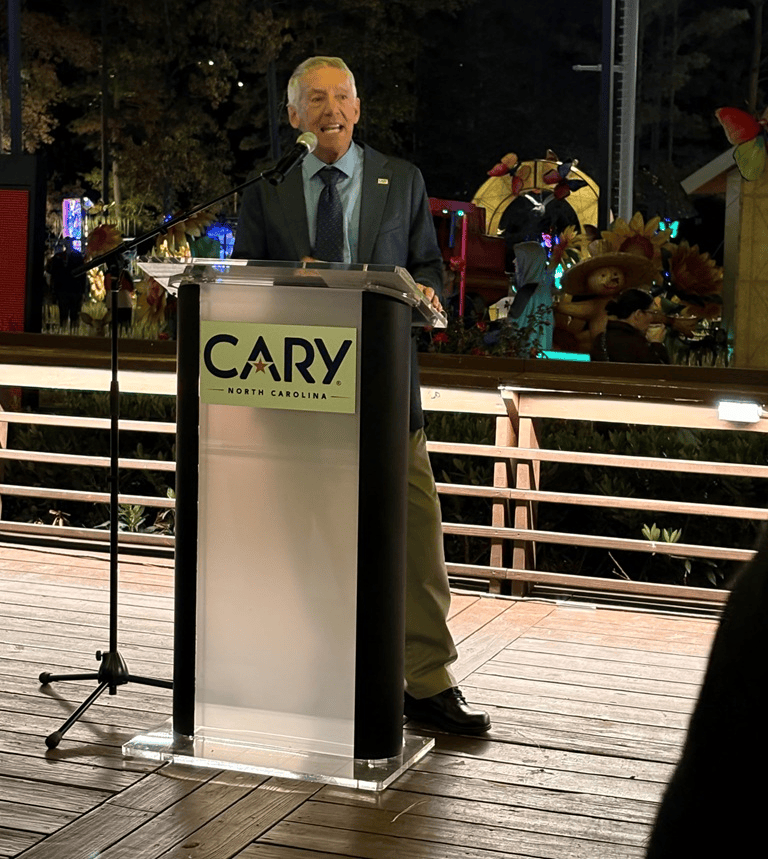
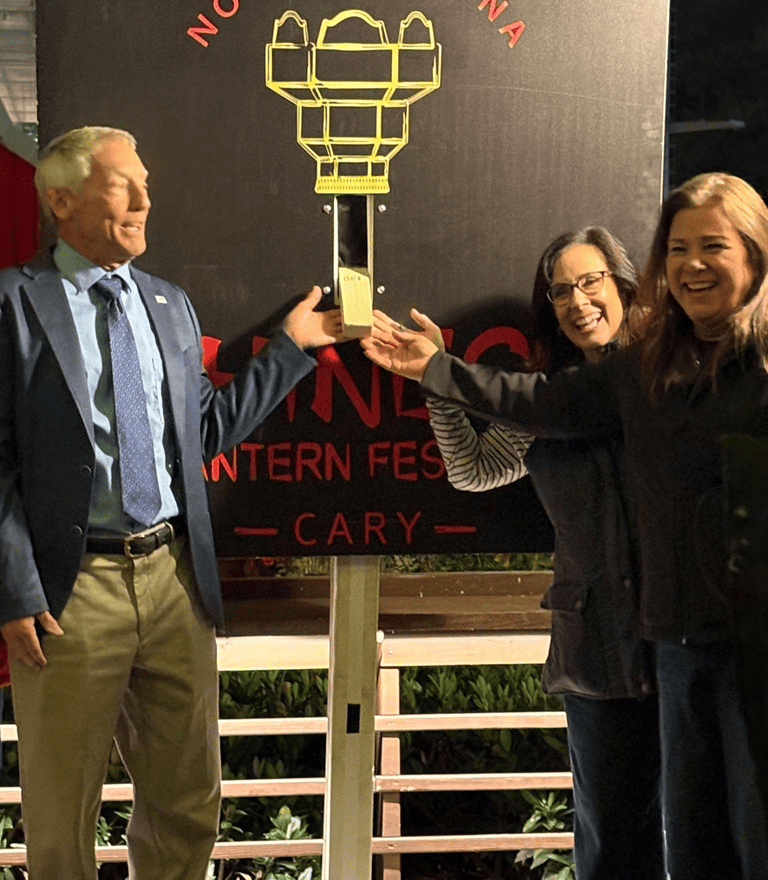
Friday evening, I joined five of my six fellow Town Council members, two North Carolina House representatives, and two elected officials from neighboring municipalities for the “Flip the Switch” ceremony, officially kicking off the Chinese Lantern Festival. I had the opportunity to share a few remarks before we came together to flip the switch and illuminate the festival.
Now in its eleventh year, the festival has become a wonderful Cary tradition and a major attraction for our community. Last year, it welcomed 249,360 visitors over eight weeks, representing all 50 states and eight countries. The festival also had 22 sold-out nights and, according to the Greater Raleigh Convention and Visitors Bureau, generated an estimated $11.6 million in direct economic impact.
I encourage everyone to come experience this incredible event and see for yourself what makes it so special. And remember, the lantern displays change every year, so even if you’ve visited before, there is always something new to discover!
It’s another great example of what makes Cary such a special place to live, work, and visit.
Fenton Tree Lighting
Friday night, I had the pleasure of delivering welcoming remarks at the Fenton Christmas Tree Lighting program. Now in its fifth year, this event is quickly becoming one of the region’s most popular holiday traditions!
The evening featured a wonderful lineup of entertainment, including a performance by the Rockettes dancers, a song by Lowell, an acrobatic performance by Tori, a vocalist accompanied by two dancers, and a special Nutcracker doll performance by a talented dancer. It was a festive evening filled with holiday spirit and great entertainment!
The celebration officially kicks off the holiday season in Cary, with plenty more festivities ahead, including the holiday light displays in downtown Cary, the Town of Cary Christmas Tree Lighting on December 5, and the Jaycees Christmas Parade on December 12.
It’s a wonderful time of year in Cary, and I’m grateful to be part of a community that comes together to make the holiday season so special!
Town Manager’s Report
Council,
Today, Rebecca Badgett and Bill Rivenbark from UNC School of Government visited Town Hall to lead a training session for our unit assistance list. The training focused on strengthening internal controls, p-card management, and fund balance practices, providing helpful information as we continue working to improve our overall financial health.
As a reminder, Town Hall and most staffed facilities will be closed next Thursday and Friday for Thanksgiving. With the holiday, we will not be sending a Weekly Report next week.
I hope you all have a great weekend and enjoy some time with family and friends over Thanksgiving!
Russ Overton
Cary Town Manager
Water Resources Update
With regional rainfall below normal, Cary is closely monitoring developing dry conditions and taking proactive steps to respond. Cary currently has a 223-day water supply, which is within the normal range of 200 to 300 days. Water use restrictions are triggered when the supply drops to 120 days.
So far this year, the lowest recorded supply was 183 days on July 4. You can find the full report and the latest updates on Cary’s water supply here.
Moving Forward Dashboard
Cary has updated its Moving Forward Dashboard to reflect progress through this week, changing the status of one recommendation to Complete (OSA 13) and three recommendations to Development (OSA 02, OSA 08, and CB 03).
GoCary Bus Operations and Maintenance Facility Groundbreaking
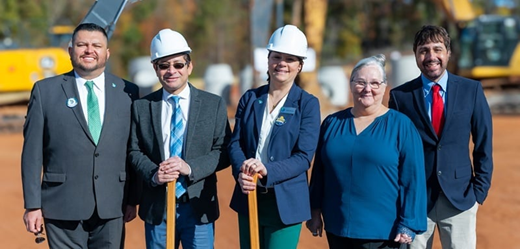
On Saturday, Cary celebrated the groundbreaking of its new GoCary Bus Operations and Maintenance Facility. The event brought together local and county elected officials, regional transit partners, community stakeholders, and staff to mark this milestone as GoCary celebrates 25 years of service. Remarks highlighted the collaboration and dedication that helped bring the project to this point. The new 85,000-square-foot facility will bring transit operations, maintenance, fueling, and vehicle storage together in one location, with room for future service and fleet expansion. Construction is expected to be completed in fall 2028.
NCDOT Hosts Public Meeting on US 64 Improvements
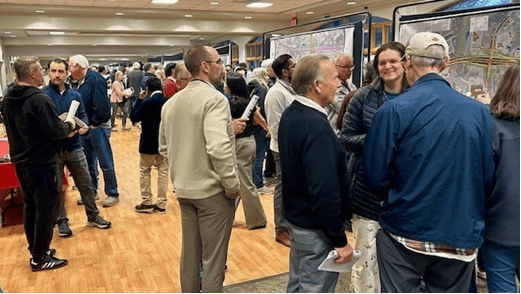
The North Carolina Department of Transportation (NCDOT) hosted a public meeting Wednesday evening to discuss proposed improvements along the U.S. 64 corridor from west of Laura Duncan Road in Apex to U.S. 1 in Cary. The meeting drew a large crowd of residents and business owners to review the proposed designs. The $342 million project includes replacing the CSX railroad bridge over U.S. 64, constructing interchanges at Laura Duncan Road and Lake Pine Drive, and separating Shepherds Vineyard Drive and Edinburgh Drive from U.S. 64 with grade-separated crossings. The improvements are intended to reduce congestion, improve traffic flow, and accommodate future growth. Construction on the railroad bridge is expected to begin in 2028, followed by highway construction in 2031. Additional information is available on the NCDOT project website.
WakeMed Soccer Park Hosts ACC Soccer Championships
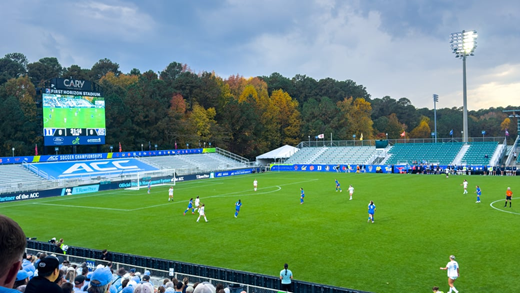
WakeMed Soccer Park welcomed its largest crowd in more than 15 years for the Atlantic Coast Conference (ACC) Men’s and Women’s Soccer Championship semifinals and finals on November 12 and 15. The University of North Carolina (UNC) Tar Heels claimed both championship titles. After hosting the ACC championships for eight consecutive seasons, WakeMed Soccer Park will welcome the 2026 National Collegiate Athletic Association (NCAA) Women’s and Men’s College Cups in December.
Cary Tennis Park Hosts Harvest Adult Tennis Tournament
Last weekend, the Cary Tennis Park hosted the 2026 Harvest Adult Tennis Tournament, showcasing the talents of 176 participants in over 15 divisions. In partnership with Western Wake Tennis Association (WWTA), the divisions included all levels of both men’s and women’s singles and doubles, along with mixed doubles.
Paint the Page
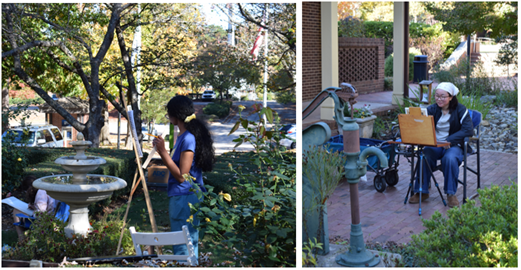
On November 8, 36 teens gathered at the Page-Walker Arts & History Center for Paint the Page, a youth art competition hosted by the Friends of the Page-Walker. The event invited students to explore Cary’s history and showcase their creativity by creating artwork inspired by the historic building and its grounds. After a guided tour of the Page-Walker, participants had less than four hours to create their artwork using a variety of materials. Students from several local high schools participated, each bringing a unique artistic perspective to capturing this piece of Cary’s history. On November 15, participants and their families returned to the Page-Walker for a reception celebrating their work and the announcement of the competition winners.
Important Dates
There are no public meetings scheduled for next week.
Mayor’s Mailbox
- Complaints about not having a pedestrian crossing at White Oak Creek Greenway connection.
- Comments about the new GoCary route in west Cary.
- A complaint about a riparian buffer in Carpenter Village.
- A complaint and a request not to allow fireworks in Cary including town events.
- A request to fund events at private schools (can’t spend taxpayer dollars on that).
- A complaint about town vehicles in parking spaces at Cary Arts Center.
- A petition to change the smoking ordinance (we did that).
- A complaint about the closing of pedestrian railroad crossings in Apex.
- A complaint about a school bus stopping on the railroad tracks.
Next Week
Next week’s activities include staff meetings and the Thanksgiving holiday. The week following Thanksgiving will include staff meetings, the First Responders Breakfast, and a Cary Tennis Classic Board meeting.
My next post will be on Sunday, December 6th, 2026. Please send all Town of Cary questions or comments to Harold.Weinbrecht@carync.gov. Note that all emails sent to me in my role as mayor are public documents.
Dashboard of Recommendations by Cherry Bekaert, OSA, and Womble Bond Dickinson
The latest updates on the Town’s actions in response to recommendations from Cherry Bekaert, the Office of the State Auditor (OSA), and Womble Bond Dickinson are available on the Town’s Moving Forward Dashboard. There are 39 recommendations in total. This link gives the progress on each of those recommendations:
https://www.carync.gov/connect-engage/newsroom/bottom-line/moving-forward-dashboard
You can also sign up to receive notifications whenever the dashboard is updated.
Council Initiated Items
The council has a process that allows members to introduce items for discussion at meetings, often leading to further action. Given the recent increase in these requests, I will begin sharing them here along with my perspective on their pros and cons.
Partnering with the school board to pilot school zone safety improvements
This proposal was submitted by Council Member Bansal, and I provided the second. It was brought up at the May 28th Council meeting.
Several schools in Cary, particularly middle schools and high schools, are experiencing transportation safety concerns on and around school property. While the schools are responsible for transportation operations on campus and NCDOT oversees roadway infrastructure decisions, progress on improvements has been slow and resident complaints have continued to increase. This proposal would direct staff to work collaboratively with the schools on programs and strategies to help address these concerns.
PROS:
- Allows the Town to take a more proactive role, even when we are not the primary decision-maker.
- Responds to growing community concerns regarding school transportation safety.
CONS:
- The Town is currently understaffed, so this effort could require shifting staff resources away from other projects.
- Potential solutions could result in additional costs to taxpayers if Cary contributes funding toward implementation.
E-Bike Safety
This proposal was submitted by Council Members Bansal and Richards and presented at the April 16th meeting. It was part of our June 23rd work session.
The council initially launched a pilot program in June 2022 to allow e-bikes. After a one-year trial period, the program was made permanent, with a posted speed limit of 15 mph on greenways. Recently, however, there have been complaints that e-bikes, scooters, and similar devices are traveling at excessive speeds and creating potentially hazardous conditions.
PROS:
- We are listening to our citizens’ complaints.
- Preventing e-bikes and scooters will possibly make greenways safer.
CONS:
- There is basically no way to enforce an ordinance that has e-bikes or not.
- Any enforcement effort would require additional officers and officers’ time. We are currently underfunding officers and require overtime to maintain existing levels of service.
- We are revisiting a decision that was made after a one-year trial and review of data.
Council will vote on a draft ordinance of this later this year.
Affordable Housing on Old Library Site
This proposal, submitted by Mayor Pro Tem Bush and Council Member Bansal, would place a podium-style parking deck with affordable housing on the former library site. This has yet to be scheduled for a meeting agenda.
PROS:
- Adds parking across from Downtown Cary Park.
- Create affordable housing units in the downtown area.
CONS:
- May underutilize one of the municipality’s most valuable properties. Downtown Cary Park generates approximately $16 million annually in economic impact, and this site could represent an opportunity for a more transformative use.
- The town has already invested millions in renovating the Ivey-Ellington House, positioning this area as a premier destination.
How Cary Government Works
Cary’s government, like most cities in North Carolina and most mid-sized cities in the U.S., uses a council–manager form of government. This system works a lot like a company, but for local government. Residents elect a council and a mayor, who set policy by passing laws, approving the budget, and guiding the town’s overall priorities. The council then hires a professional manager to run the town’s day-to-day operations.
Think of it like a company: the council acts like a board of directors, making policy and representing the public, while the city manager acts like a CEO, overseeing all departments, such as finance, public works, police, and fire, and managing town staff. The mayor leads council meetings, represents the town publicly, and has limited executive authority. While the council and mayor make policy decisions and receive regular reports, they usually see only high-level summaries rather than the detailed inner workings of each department.
In short, just as a board hires a CEO to run a company, Cary’s council hires a manager to run the town, ensuring professional management while elected officials focus on big-picture decisions and community priorities.
You can find additional information about how Cary’s government works on the town’s website here.
Purpose of this Blog
It is my hope that this blog will provide insight not only into who I am meeting with on behalf of the Town, but also the topics we discuss. I believe strongly in open and transparent government. This blog is one of several initiatives I implemented when I became mayor in 2007 to make the governmental process more accessible to our citizens.
This blog is written with sincerity, honesty, and a commitment to accuracy so our constituents can better understand the work we do. After all, we work for them!

